
Most Popular steroids USA
-
 Test Enanthate 200mg 20 ml Sydgroup
Original price was: $110.00.$53.00Current price is: $53.00.
Test Enanthate 200mg 20 ml Sydgroup
Original price was: $110.00.$53.00Current price is: $53.00. -
Testosterone Cypionate 300mg 20ml Sydgroup
Original price was: $99.00.$53.00Current price is: $53.00.
-
Somatrox XT Labs 150 IU x 10 vials (15 ui each)
Original price was: $450.00.$350.00Current price is: $350.00.
-
Boldenone Cypionate 200 mg / 10 mL Geno Pharma
Original price was: $90.00.$85.00Current price is: $85.00.
-
Steroid Deca Geno Pharma 300mg 10ml
Original price was: $110.00.$99.00Current price is: $99.00.
-
Eq 300 steroid Rotterdam 10ml
Original price was: $79.00.$69.00Current price is: $69.00.
-
Testosterone 400 Biopharma 10 Ampoules
Original price was: $99.00.$75.00Current price is: $75.00.
-
Testosterone Cypionate 200 Biopharma 10 amp
Original price was: $99.00.$72.00Current price is: $72.00.
-
Buy Testosterone E 300mg 10 ml Geno Pharma Domestic USA/CA
$99.00
-
Testosterone Cypionate Buy 300mg 10ml Geno Pharma
$99.00
-
Buy Anavar 10mg – Purchase Geno Pharma
$99.00
-
Anavar for Sale in USA – 10mg 80 Tabs GPH-Premium
Original price was: $110.00.$80.00Current price is: $80.00.
-
NPP Steroid 100mg 10 ml Premium Domestic USA
Original price was: $99.00.$80.00Current price is: $80.00.
-
Primobolan for sale 100mg 10 ml Human Pharma in USA
$115.00









Interest in retatrutide dosage has increased rapidly as the investigational triple agonist has progressed through Phase 2 and Phase 3 clinical development. Searchers commonly want to know the same practical things: What dose of retatrutide has actually been studied? What dose did researchers start with? How quickly was it increased? Is 12 mg really necessary? Can side effects occur at only 2 mg? And what might an eventual FDA-approved retatrutide dosing schedule look like?
The most important distinction is that retatrutide still does not have an FDA-approved dosage or dosing schedule. As of August 2026, Eli Lilly describes retatrutide as an investigational once-weekly GIP, GLP-1, and glucagon receptor agonist that has not been approved by the FDA or any other regulatory agency. FDA likewise states that retatrutide has not been found safe and effective for any condition and cannot currently be used in compounding under federal law.
That does not mean nothing is known about dosing. Quite the opposite. Multiple clinical trials have now studied retatrutide at different exposures, beginning with relatively low doses and progressing to target doses as high as 12 mg once weekly. Phase 2 obesity research tested 1 mg, 4 mg, 8 mg, and 12 mg target doses, while the major Phase 3 TRIUMPH program has focused primarily on 4 mg, 9 mg, and 12 mg target doses after beginning treatment at 2 mg and increasing exposure gradually.
The unanswered question is not simply, “What numbers were used?”
The more clinically meaningful question is:
What happened to efficacy and tolerability as retatrutide exposure increased?
That distinction matters because the highest dose generally produced the greatest average weight reduction, but higher-dose groups also experienced more gastrointestinal adverse events and, in several trials, more treatment discontinuation. In the Phase 2 obesity trial, gastrointestinal adverse events were specifically described as dose-related, occurred primarily during dose escalation, and were partially mitigated when participants began at 2 mg instead of 4 mg.
This guide examines that relationship in detail rather than treating the largest number studied as automatically being the “best retatrutide dose.”
What Is the Retatrutide Dosage?
There is currently no approved retatrutide dosage for weight loss, obesity, diabetes, or any other medical condition. The doses discussed in medical literature are investigational doses administered to participants enrolled in controlled clinical trials.
In Phase 2 obesity research, retatrutide was administered subcutaneously once weekly at target doses of 1 mg, 4 mg, 8 mg, or 12 mg. Participants assigned to target doses of 4 mg or higher sometimes began at either 2 mg or 4 mg, allowing investigators to study whether a lower starting exposure improved tolerability.
Phase 3 development changed that approach. In TRIUMPH-1, participants assigned to active treatment began at 2 mg once weekly and increased their dose stepwise every four weeks until reaching target doses of 4 mg, 9 mg, or 12 mg. The 9 mg arm passed through 2 mg, 4 mg, and 6 mg, while the 12 mg arm passed through 2 mg, 4 mg, 6 mg, and 9 mg before reaching its assigned target.
That design immediately reveals something important:
A “12 mg retatrutide group” does not mean participants started treatment at 12 mg.
They spent months progressing toward that exposure.
The same principle applies when reading trial results for 9 mg or 12 mg. The target dose represents the intended maintenance exposure after escalation, not the first injection received.
Retatrutide Dosage at a Glance
The following table summarizes the major dose levels that appear throughout retatrutide clinical development.
| Retatrutide Dose | How It Has Been Used in Research | Major Context | Key Point |
|---|---|---|---|
| 0.5 mg | Low-dose target in Phase 2 diabetes research | Type 2 diabetes | Demonstrated that lower exposure was also investigated |
| 1 mg | Low target dose | Phase 2 obesity | Produced measurable weight loss without being part of the later Phase 3 target-dose structure |
| 2 mg | Starting dose in major Phase 3 trials | TRIUMPH and TRANSCEND | Used primarily to begin treatment before escalation |
| 4 mg | Target dose and escalation level | Phase 2 and Phase 3 | Important lower maintenance target with substantial efficacy |
| 6 mg | Intermediate escalation level | Phase 3 | Primarily used as a step toward 9 mg or 12 mg |
| 8 mg | High target dose | Phase 2 | Produced substantial weight loss; not retained as a principal Phase 3 target |
| 9 mg | Major Phase 3 target dose | TRIUMPH and TRANSCEND | One of the principal higher maintenance targets studied |
| 12 mg | Highest major target dose | Phase 2 and Phase 3 | Produced the greatest or near-greatest average efficacy in several studies but also a greater tolerability burden |
Phase 2 and Phase 3 did not use identical dose structures. Phase 2 obesity research used 1, 4, 8, and 12 mg target doses, whereas TRIUMPH Phase 3 studies shifted toward 4, 9, and 12 mg targets while using 2 and 6 mg primarily as escalation steps.
That evolution is important because clinical development is not simply a process of testing progressively larger numbers. Researchers use earlier studies to determine which doses produce meaningful efficacy, which exposures become difficult to tolerate, and how dose escalation can be modified before moving into larger registrational trials.
Retatrutide Starting Dose vs. Target Dose vs. Maintenance Dose
One of the biggest sources of confusion surrounding retatrutide dosing is the use of several different dose-related terms as though they mean the same thing.
They do not.
Starting Dose
The starting dose is the exposure used when treatment is initiated.
In major Phase 3 TRIUMPH trials, that dose was 2 mg once weekly.
Its purpose was not to represent the maximum therapeutic effect expected from retatrutide. It functioned as the first step in an escalation process intended to introduce participants gradually to the medication.
Escalation Dose
An escalation dose is an intermediate exposure used while progressing toward another target.
For example, 6 mg appears throughout the Phase 3 program as a step between 4 mg and 9 mg. In the 12 mg pathway, 9 mg similarly functions as an intermediate step before the final target is reached.
This matters for anyone searching phrases such as “retatrutide 6 mg dosage.” Six milligrams has been part of clinical development, but it has not served the same role as the principal 4 mg, 9 mg, and 12 mg Phase 3 target arms.
Target Dose
The target dose is the exposure a participant is assigned to reach if the protocol and tolerability permit.
TRIUMPH-1 used:
- 4 mg
- 9 mg
- 12 mg
as its active target-dose groups.
TRANSCEND-T2D-1, the published Phase 3 trial in adults with type 2 diabetes controlled inadequately through diet and exercise alone, also evaluated 4 mg, 9 mg, and 12 mg target doses.
Maintenance Dose
“Maintenance dose” is often used informally when discussing the dose maintained after escalation. However, there is no FDA-approved retatrutide maintenance dose yet.
It is therefore more precise to describe 4 mg, 9 mg, and 12 mg as Phase 3 target doses rather than calling them officially approved maintenance doses.
If retatrutide eventually receives regulatory approval, regulators could approve one maintenance dose, several maintenance doses, or a treatment strategy different from the trial protocols. That decision has not yet been made.
Why Retatrutide Researchers Did Not Simply Start at the Highest Dose
The Phase 2 obesity study provides one of the clearest answers.
Investigators deliberately compared some participants who began at 2 mg with others who began at 4 mg before progressing toward higher target doses. Gastrointestinal events—including nausea, diarrhea, vomiting, and constipation—were more common at higher exposures, occurred particularly during dose escalation, and were partially reduced when the initial dose was 2 mg rather than 4 mg.
This finding is one of the most important pieces of evidence for understanding the later Phase 3 dosing strategy.
Phase 3 did not simply repeat the Phase 2 design.
Instead, major TRIUMPH studies standardized a 2 mg starting dose, followed by stepwise increases every four weeks.
That evolution strongly suggests that tolerability—not only maximum efficacy—helped shape the later dosing strategy.
The distinction is critical because someone reading only the headline Phase 2 result of 24.2% mean weight reduction with 12 mg at 48 weeks could mistakenly conclude that researchers simply administered 12 mg from the beginning. They did not. The 12 mg group in Phase 2 began at 2 mg, and the medication was escalated gradually.
Why Retatrutide 2 mg dose Deserves More Attention Than It Usually Gets
The 2 mg dose receives less attention than 8 mg, 9 mg, or 12 mg because it is not responsible for the most dramatic weight-loss headlines.
From a tolerability perspective, however, 2 mg may be one of the most important doses in the entire development program.
It became the standardized starting exposure used across the major Phase 3 TRIUMPH program. Lilly states that participants assigned to active treatment across these studies initiated retatrutide at 2 mg once weekly before escalating every four weeks.
The significance of 2 mg should not be misunderstood.
It does not mean:
- 2 mg is an FDA-approved starting dose.
- 2 mg is side-effect free.
- Everyone can tolerate 2 mg.
- Everyone should begin at 2 mg.
- 2 mg will necessarily appear in an eventual commercial label.
Instead, it tells us that the Phase 3 program considered a lower introductory exposure important enough to standardize across thousands of participants.
Can Retatrutide Cause Side Effects at 2 mg?
Yes, adverse effects can occur before a participant reaches the highest retatrutide doses. However, the available clinical data do not provide a simple standalone adverse-event percentage that tells us exactly what proportion of people will experience nausea or diarrhea specifically while receiving only 2 mg.
That distinction is important.
The Phase 2 obesity trial did not contain a dedicated “2 mg maintenance arm.” Instead, 2 mg was used as the initial dose for participants who would later progress toward 4 mg, 8 mg, or 12 mg. The trial nevertheless found that gastrointestinal events occurred primarily during dose escalation and that using 2 mg as the starting dose reduced—but did not eliminate—those events compared with beginning at 4 mg.
Therefore, the evidence supports two conclusions simultaneously:
First: lower starting exposure improved tolerability at a group level.
Second: starting lower did not guarantee that gastrointestinal symptoms would not occur.
This is where clinical-trial averages can be misleading if interpreted too simplistically.
A statement such as:
“Participants started at only 2 mg.”
may sound reassuring.
But “only 2 mg” is not a pharmacologic category. Individuals differ in receptor sensitivity, baseline gastrointestinal function, body composition, food intake, metabolic status, concurrent medications, and how quickly systemic exposure accumulates.
Some people can experience meaningful gastrointestinal effects at exposures that another person tolerates with little difficulty.
Nausea and Diarrhea Can Occur Before High-Dose Retatrutide
Nausea and diarrhea were among the most commonly reported gastrointestinal adverse events in retatrutide development. In Phase 2 obesity research, gastrointestinal adverse events were dose-related and appeared most frequently during escalation. Higher-dose groups experienced them more frequently than lower-dose groups, but they were not limited exclusively to people who had already reached 8 mg or 12 mg.
This is important when interpreting anecdotal reports from people who say they experienced nausea, diarrhea, vomiting, or unusually strong appetite suppression at comparatively low doses.
Such reports should not be treated as equivalent to clinical evidence. Products obtained outside Lilly clinical trials cannot necessarily be verified for identity, concentration, purity, sterility, or actual administered amount. Lilly states that anything sold to consumers outside its trials cannot be verified for purity or dosing, while FDA has specifically warned about unapproved products sold under the retatrutide name.
Nevertheless, the general idea that gastrointestinal intolerance can emerge before the highest target doses are reached is consistent with the controlled clinical-trial evidence.
What the trials do not support is defining a universal threshold such as:
“Side effects start at 4 mg.”
or:
“2 mg is always easy to tolerate.”
Neither statement accurately reflects individual variability.
Does Retatrutide Become Harder to Tolerate as the Dose Increases?
The Phase 2 evidence indicates that, on average, the answer is yes.
Overall adverse events were reported in 73% to 94% of participants across retatrutide groups, with the highest incidence occurring in the 8 mg and 12 mg groups. Gastrointestinal events were more frequent at higher doses, and adverse events resulted in treatment discontinuation in approximately 6% to 16% of participants receiving retatrutide.
The specific Phase 2 discontinuation rates also illustrate why target dose cannot be evaluated using weight loss alone.
Participants discontinued because of adverse events at rates ranging from:
- 6% in one 4 mg group,
- to 14% in the 8 mg group that began at 2 mg,
- and 16% in the 12 mg group that began at 2 mg.
These numbers should be interpreted cautiously because the individual treatment arms were relatively small. They nevertheless show that higher efficacy came with a meaningful tolerability trade-off.
This pattern becomes even more important in Phase 3, where far larger populations provide additional information about what happened at the 4 mg, 9 mg, and 12 mg targets.
Why the Highest Retatrutide Dose Is Not Automatically the “Best Dose”
In the Phase 2 obesity trial, average weight reduction at 48 weeks was:
| Target Dose | Mean Weight Change at 48 Weeks |
|---|---|
| 1 mg | −8.7% |
| 4 mg | −17.1% |
| 8 mg | −22.8% |
| 12 mg | −24.2% |
| Placebo | −2.1% |
The dose-response relationship is obvious: higher target doses generally produced greater average weight reduction.
But notice something equally important.
Moving from 4 mg to 8 mg was associated with an additional average reduction of approximately 5.7 percentage points.
Moving from 8 mg to 12 mg added approximately 1.4 percentage points to the average weight reduction at week 48.
Meanwhile, gastrointestinal events became more frequent in the higher-dose groups, and the 12 mg group had one of the highest treatment-discontinuation rates related to adverse events.
This does not prove that 8 mg is preferable to 12 mg, or that 4 mg is preferable to either.
It demonstrates something more important:
The relationship between dose and benefit is not the same thing as the relationship between dose and overall clinical value.
A higher exposure can produce additional efficacy while simultaneously increasing the probability that some participants will struggle to tolerate treatment.
That efficacy-versus-tolerability relationship will become one of the central questions if retatrutide eventually reaches regulatory review for commercial use.
Why the 4 mg Retatrutide Dose Is Particularly Interesting
Among the Phase 3 targets, 4 mg deserves closer attention because it represents the lowest principal target retained in TRIUMPH-1, TRIUMPH-2, and TRANSCEND-T2D-1.
It is therefore much more than an intermediate stepping stone.
In the Phase 2 obesity study, the combined 4 mg groups achieved an average 17.1% weight reduction at 48 weeks, compared with 2.1% with placebo. At least 5% weight reduction was achieved by 92% of participants assigned to 4 mg, while 75% achieved at least 10% and 60% achieved at least 15%.
Phase 3 subsequently retained 4 mg as a target alongside 9 mg and 12 mg rather than requiring every participant to reach a high-dose target.
That design raises an important question that we will examine more closely later in this article:
Could an eventual retatrutide treatment strategy involve multiple maintenance targets rather than requiring everyone to reach the highest dose studied?
At present, that remains an inference rather than an approved recommendation.
But the clinical development program gives us a strong reason to ask the question.
Retatrutide Dosing Schedule, Dose Escalation, and What a Future Schedule Could Look Like
Retatrutide Dosing Schedule in Clinical Trials
The retatrutide dosing schedule is one of the most searched aspects of the drug because the clinical development program provides enough information to show how researchers have approached treatment, even though no FDA-approved schedule exists.
Across the major obesity and diabetes trials, one principle has remained consistent: retatrutide has been studied as a once-weekly subcutaneous medication, and higher target doses have generally been reached through gradual dose escalation rather than immediate exposure to the final dose.
That distinction matters because a table showing only “4 mg, 9 mg, and 12 mg” leaves out one of the most important aspects of retatrutide development. Those are target doses, not necessarily the amount participants received from the beginning.
The Phase 3 program provides the clearest example. Participants assigned to retatrutide started at 2 mg once weekly and moved upward in four-week steps until reaching the target assigned by the trial.
Retatrutide Phase 3 Dosing Schedule Used in Research
| Treatment Period | 4 mg Target Arm | 9 mg Target Arm | 12 mg Target Arm |
|---|---|---|---|
| Weeks 1–4 | 2 mg | 2 mg | 2 mg |
| Weeks 5–8 | 4 mg | 4 mg | 4 mg |
| Weeks 9–12 | 4 mg | 6 mg | 6 mg |
| Weeks 13–16 | 4 mg | 9 mg | 9 mg |
| Week 17 and Later | 4 mg | 9 mg | 12 mg |
Important: This table describes the dosing structure used in major Phase 3 clinical trials. It is not an FDA-approved retatrutide dosing schedule and should not be interpreted as instructions for self-administration. Retatrutide remains investigational.
The schedule reveals several important characteristics of the development strategy:
- Retatrutide was administered once weekly.
- Phase 3 active-treatment groups began at 2 mg.
- Escalation generally occurred at four-week intervals.
- 4 mg was both an intermediate exposure and a final target dose.
- 6 mg primarily functioned as an intermediate escalation step.
- 9 mg could function either as a final target or as an intermediate step toward 12 mg.
- Participants assigned to 12 mg did not reach that target until approximately the fifth four-week treatment period.
This structure is critical when interpreting both efficacy and side-effect data.
A participant classified in the “12 mg group” spent the first several months receiving lower doses. Therefore, an 80-week result reported for the 12 mg arm does not represent 80 uninterrupted weeks of 12 mg exposure.
Retatrutide Phase 2 Dosing Schedule
Phase 2 development was more exploratory.
The obesity trial randomized participants to:
- 1 mg
- 4 mg with a 2 mg initial dose
- 4 mg with a 4 mg initial dose
- 8 mg with a 2 mg initial dose
- 8 mg with a 4 mg initial dose
- 12 mg with a 2 mg initial dose
- Placebo
All treatments were administered once weekly for 48 weeks. For target doses of 4 mg or higher, investigators used starting doses of either 2 mg or 4 mg and gradual escalation at four-week intervals for up to 12 weeks.
The design was deliberately useful for answering a tolerability question:
Does beginning treatment at a lower exposure make higher retatrutide target doses easier to tolerate?
The trial found that gastrointestinal adverse events were dose-related and were partially mitigated by beginning at 2 mg rather than 4 mg.
That finding appears to have influenced later development. Phase 3 moved away from giving some participants a 4 mg initial exposure and instead standardized the initial active-treatment dose at 2 mg in major TRIUMPH and TRANSCEND studies.
In other words, the dosing schedule evolved as investigators learned more about tolerability.
How Phase 2 Changed the Retatrutide Phase 3 Dosing Strategy
The shift from Phase 2 to Phase 3 is one of the most informative parts of the retatrutide program.
Phase 2 was asking questions such as:
- Which target doses produce meaningful weight reduction?
- Is the response dose-dependent?
- How much does starting exposure affect tolerability?
- Can 8 mg and 12 mg be reached safely enough to justify larger trials?
- Are gastrointestinal events concentrated during escalation?
The Phase 2 results showed substantial efficacy but also a clear gastrointestinal tolerability signal. Nausea, diarrhea, vomiting, and constipation were among the most common adverse events; events were more frequent with higher doses and concentrated around escalation. A lower 2 mg starting exposure improved tolerability relative to beginning at 4 mg, although it did not eliminate gastrointestinal events.
Phase 3 then implemented a much more standardized structure:
2 mg → 4 mg → 6 mg → 9 mg → 12 mg
with each applicable step separated by approximately four weeks.
This is a good example of why clinical development cannot be reduced to simply identifying the dose that produced the most weight loss. Researchers also have to determine how patients reach that exposure and whether enough patients can remain there.
Why Does Retatrutide Use a Once-Weekly Schedule in Clinical Trials?
Retatrutide’s pharmacokinetics support once-weekly administration.
An early Phase 1b study found that retatrutide exposure was approximately dose-proportional and that the molecule had a plasma half-life of approximately six days. Investigators concluded that its pharmacokinetic properties supported once-weekly administration.
A half-life of approximately six days means appreciable drug exposure remains when the next weekly research dose is administered.
Repeated doses therefore overlap rather than disappearing completely between injections.
This has several implications for interpreting retatrutide dosing:
- Exposure can accumulate during repeated weekly administration.
- The effect of a new dose level cannot necessarily be judged from the first injection at that level.
- Tolerability over several weeks may be more informative than tolerability during the first few days.
- Escalating too rapidly would provide less time to evaluate the effect of accumulated exposure.
The half-life alone does not prove that four weeks is the only appropriate escalation interval. However, the pharmacokinetic profile and the gastrointestinal tolerability findings from earlier studies together help explain why later clinical trials used gradual, multi-week escalation rather than rapid increases.
Why Were Retatrutide Doses Increased Every Four Weeks?
The four-week intervals used in major Phase 3 studies serve an important research purpose: investigators can observe how participants respond to one exposure level before moving them to the next.
Retatrutide’s approximately six-day half-life means four weeks represents several elimination half-lives. This provides substantially more information about repeated exposure than increasing the dose after only one injection.
More importantly, Phase 2 showed that gastrointestinal adverse events occurred mainly during dose escalation. The move toward a lower starting exposure and staged escalation was therefore not arbitrary; it was informed by earlier safety and tolerability observations.
The practical concept being tested is straightforward:
Higher exposure may produce greater efficacy, but reaching higher exposure gradually may make treatment more tolerable than introducing it abruptly.
Even gradual escalation does not guarantee tolerability.
Some participants still experienced:
- Nausea
- Diarrhea
- Vomiting
- Constipation
- Reduced food intake
- Other adverse events
- Treatment interruption
- Dose reduction
- Permanent discontinuation
The existence of an escalation schedule should therefore not be interpreted to mean every participant proceeded through every step without difficulty.
What Happens When a Participant Cannot Tolerate the Next Retatrutide Dose?
This is where looking only at the neat 2 → 4 → 6 → 9 → 12 mg sequence becomes misleading.
The TRIUMPH program was designed with mechanisms for participants who could not tolerate the assigned escalation pathway.
A peer-reviewed description of the TRIUMPH program states that a permanent dose reduction could be permitted for gastrointestinal adverse events or inadequate oral intake when those problems failed to improve with other mitigation measures, including an earlier de-escalation and re-escalation attempt. Dose reduction could also occur if a participant reached a BMI of 22 kg/m² or lower or felt that excessive weight had been lost.
This tells us something extremely important about the interpretation of a target dose.
Assigned dose is not always identical to tolerated dose.
A participant assigned to a 12 mg arm could potentially encounter tolerability issues before or after reaching the target. Trial protocols allowed investigators to respond rather than treating completion of the escalation pathway as mandatory under all circumstances.
The TRIUMPH-1 extension makes this concept even clearer. Participants with a baseline BMI of at least 35 who entered the extension could undergo blinded escalation toward a maximum tolerated dose of 9 mg or 12 mg, emphasizing tolerability rather than assuming that 12 mg had to be reached by every participant.
This may eventually prove important for how retatrutide is used clinically if approved.
Target Dose Does Not Mean Mandatory Dose
The phrase target dose is easy to misinterpret.
In a clinical trial, it identifies the exposure the participant was randomized to reach under the protocol. It does not mean:
- everyone reached it,
- everyone tolerated it,
- everyone remained on it,
- everyone needed it for meaningful weight loss, or
- it will become the recommended dose after approval.
This is particularly important because retatrutide demonstrated considerable efficacy at 4 mg.
In TRIUMPH-1, Lilly reported an average 19.0% weight reduction at 80 weeks under the efficacy estimand for the 4 mg target group. That group required only one escalation from the 2 mg starting exposure to 4 mg. Lilly also reported a lower observed adverse-event discontinuation rate in that group than with placebo.
By contrast, reaching 9 mg or 12 mg required several additional escalation steps. Those groups achieved greater average weight reduction, but they also experienced a greater overall tolerability burden in several trial analyses.
The important question is therefore not:
“How do you get everyone to 12 mg?”
It is:
“How much additional benefit is gained at each higher exposure, and how much additional tolerability burden accompanies that benefit?”
That question will become much more important in Part 3 when we compare 4 mg, 8 mg, 9 mg, and 12 mg directly.
What Happens When Retatrutide Increases From 2 mg to 4 mg?
The transition between 2 mg and 4 mg deserves special attention because it is the first up-titration used in the major Phase 3 program.
Two milligrams functions primarily as an introductory exposure. Four milligrams is different because it can represent either:
- the first escalation step for participants heading toward higher doses, or
- the final target for participants randomized to the 4 mg arm.
This makes 4 mg one of the most informative doses in the entire program.
For someone assigned to 4 mg in TRIUMPH-1, the escalation period was relatively short:
2 mg for the introductory period → 4 mg target
By contrast, the 12 mg pathway required progression through multiple intermediate exposures before reaching the final target.
Phase 2 already demonstrated that gastrointestinal tolerability was sensitive to starting exposure, with a 2 mg introduction being better tolerated on average than beginning directly at 4 mg.
That finding does not mean that 4 mg represents a universal threshold at which side effects begin. Some participants can experience gastrointestinal adverse effects at lower exposure, while others may tolerate substantially higher target doses.
It does, however, show why the 2-to-4 mg transition is pharmacologically and clinically more meaningful than simply viewing 2 mg and 4 mg as nearby numbers.
Do Side Effects Start When Retatrutide Reaches 4 mg?
There is no clinical evidence establishing 4 mg as a universal side-effect threshold.
The evidence instead supports a dose-response pattern.
Phase 2 investigators reported that gastrointestinal adverse events were dose-related and occurred primarily during escalation. Beginning at 2 mg reduced the burden relative to beginning at 4 mg, but the study did not establish a single dose below which nausea, diarrhea, vomiting, or constipation cannot occur.
This distinction fits with the variability that can occur with pharmacologic treatment generally.
Two people assigned to the same trial exposure may not experience identical:
- Appetite effects
- Gastric-emptying effects
- Nausea
- Diarrhea
- Vomiting
- Satiety
- Weight loss
- Treatment tolerability
Clinical-trial percentages describe populations. They do not define the exact dose at which an individual will first experience an adverse effect.
That is why anecdotal claims such as “2 mg has no side effects” and “everyone develops side effects above 4 mg” both go beyond what controlled evidence supports.
The more defensible conclusion is:
Retatrutide gastrointestinal intolerance can occur at relatively early exposure, and the probability and/or severity of adverse effects generally increases as exposure rises, although individual tolerability varies.
What Happens Above 4 mg?
Once the intended target exceeds 4 mg, the Phase 3 structure becomes progressively longer.
For a 9 mg target:
2 mg → 4 mg → 6 mg → 9 mg
For a 12 mg target:
2 mg → 4 mg → 6 mg → 9 mg → 12 mg
Each step was separated by four weeks in TRIUMPH-1 and TRANSCEND-T2D-1.
This means someone in the 12 mg research arm spent approximately:
- four weeks at 2 mg,
- four weeks at 4 mg,
- four weeks at 6 mg,
- four weeks at 9 mg,
before beginning the assigned 12 mg target exposure.
The gradual structure itself suggests that Lilly’s development program did not treat movement from 4 mg to 12 mg as pharmacologically trivial.
Each additional step provided time for exposure and tolerability to be assessed.
The Phase 3 program also preserved multiple final targets—4 mg, 9 mg, and 12 mg in several trials—rather than studying only 12 mg.
That is important when considering what an eventual commercial dosing strategy might look like.
Will Everyone Need to Reach 12 mg of Retatrutide?
Based on the clinical development program, there is no evidence that everyone would need to reach 12 mg if retatrutide is eventually approved.
Twelve milligrams is the highest principal target evaluated repeatedly in Phase 2 and Phase 3, but lower target doses have also demonstrated substantial efficacy.
TRIUMPH-1 retained 4 mg and 9 mg alongside 12 mg. TRANSCEND-T2D-1 likewise evaluated all three target doses. TRIUMPH-2 also randomized participants to 4 mg, 9 mg, and 12 mg.
That design would make little sense if researchers already knew that only 12 mg had meaningful clinical value.
The dose-response results instead suggest a continuum:
Lower exposure → meaningful efficacy with generally less escalation burden
Higher exposure → greater average efficacy with greater tolerability considerations
This is precisely why future regulatory decisions will need to consider more than the dose producing the largest average percentage reduction in weight.
Could 4 mg Become a Future Retatrutide Maintenance Dose?
It is plausible, but it is not yet known.
The strongest reason to consider this possibility is that 4 mg was deliberately retained as a Phase 3 target rather than merely an escalation step.
In TRIUMPH-1, the 4 mg group achieved an average 19.0% weight reduction at 80 weeks under the efficacy estimand.
In the peer-reviewed TRANSCEND-T2D-1 study, the 4 mg group achieved a mean 11.5% body-weight reduction at week 40 under the treatment-regimen estimand while also producing a substantial reduction in HbA1c.
Those are different populations and cannot be compared directly, but both demonstrate that 4 mg was pharmacologically active and clinically meaningful within controlled trials.
Therefore, one reasonable interpretation is that an eventual retatrutide label could potentially contain more than one maintenance option.
However, regulators could:
- retain 4 mg,
- modify its role,
- approve different target doses by indication,
- approve only selected higher targets,
- alter escalation intervals,
- or require an entirely different structure.
Until FDA review occurs, none of these possibilities should be presented as established.
Could 9 mg Become a Future Retatrutide Maintenance Dose?
Nine milligrams may be particularly interesting because Phase 3 development positioned it between the lower 4 mg and highest 12 mg targets.
TRIUMPH-1, TRIUMPH-2, TRIUMPH-3, TRIUMPH-4, and TRANSCEND-T2D-1 have all incorporated 9 mg as either a target or an important late escalation level.
In the TRIUMPH-1 extension, participants were escalated toward a maximum tolerated dose of either 9 mg or 12 mg, further emphasizing that 9 mg can function as a meaningful high-exposure endpoint rather than merely a temporary step.
This could eventually make 9 mg relevant for patients who derive substantial benefit but do not require—or cannot comfortably remain at—the highest exposure.
That is an inference from trial design, not an approved treatment recommendation.
Could 12 mg Become the Maximum Retatrutide Dose?
Twelve milligrams is currently the highest major target dose repeatedly evaluated in the later retatrutide development program.
It is therefore reasonable to say that 12 mg provides the strongest current clue about what a potential upper commercial target might look like.
But there is an important semantic distinction:
Highest dose studied extensively ≠ FDA-approved maximum dose.
The FDA could ultimately:
- approve 12 mg as a maximum,
- approve 12 mg only for certain indications,
- approve a lower maximum,
- approve several maintenance doses,
- or request different dosing information.
Until an approved prescribing label exists, calling 12 mg the “maximum retatrutide dose” without qualification would be premature.
The more precise phrasing is:
12 mg is the highest major target dose extensively studied in the current Phase 2 and Phase 3 development program.
What Could a Future FDA-Approved Retatrutide Dosing Schedule Look Like?
This is one of the most important questions surrounding retatrutide—and it can be addressed intelligently without pretending that the answer is already known.
The Phase 3 program provides a strong evidence-based framework for what regulators will eventually evaluate.
What the Evidence Already Establishes
| Feature | What Clinical Trials Have Established |
|---|---|
| Administration frequency | Once-weekly subcutaneous administration has been used throughout major trials |
| Introductory exposure | 2 mg was standardized as the starting dose in major Phase 3 studies |
| Escalation interval | Dose increases occurred approximately every four weeks |
| Intermediate doses | 4 mg and 6 mg were used during escalation; 9 mg also served as an intermediate step toward 12 mg |
| Major Phase 3 targets | 4 mg, 9 mg, and 12 mg |
| Highest extensively studied target | 12 mg |
| Tolerability strategy | Dose reduction and de-escalation were incorporated into the Phase 3 program when necessary |
These are established characteristics of the research program, not an approved prescription.
What Can Reasonably Be Inferred
Based on those trials, it is reasonable to infer that an eventual approved retatrutide regimen could preserve several principles:
Once-weekly administration is likely to remain important. The approximately six-day half-life and the entire later-stage development program support weekly use.
A relatively low introductory dose appears likely. Phase 2 showed better gastrointestinal tolerability with a 2 mg rather than 4 mg starting exposure, and Phase 3 subsequently standardized initiation at 2 mg.
Gradual escalation is likely to remain important. Phase 3 repeatedly used four-week increments instead of moving participants rapidly to their final target.
More than one maintenance target is plausible. Major Phase 3 trials were deliberately designed around multiple target doses rather than a single 12 mg endpoint.
Tolerability may influence the final dose reached. The TRIUMPH program permits dose reduction under defined circumstances, and the TRIUMPH-1 extension explicitly used the concept of a maximum tolerated dose.
What Is Still Unknown
No evidence currently establishes the eventual:
- FDA-approved starting dose
- Official titration schedule
- Approved maintenance doses
- Maximum approved dose
- Minimum effective maintenance dose
- Missed-dose instructions
- Restarting instructions after prolonged interruption
- Dose adjustments for specific adverse effects
- Dose recommendations by renal function
- Dose recommendations by hepatic function
- Pregnancy-related discontinuation timing
- Switching protocol from semaglutide
- Switching protocol from tirzepatide
- Dose equivalence with another incretin medication
Those questions require regulatory review and approved prescribing information.
An Evidence-Based Projection of Future Retatrutide Dosing
Based solely on the design of the Phase 3 program, a future approved strategy would plausibly involve once-weekly administration, introduction at a lower exposure, gradual escalation over multiple weeks, and the ability to remain at more than one maintenance dose depending on efficacy and tolerability.
That is substantially different from assuming:
Everyone will start low and automatically continue increasing until 12 mg.
The trials themselves do not support that simplistic interpretation.
The existence of a 4 mg target, a 9 mg target, dose-reduction provisions, and a maximum-tolerated-dose concept in the TRIUMPH extension all suggest that individual tolerability could become an important part of eventual clinical dose selection.
The exact values cannot be predicted confidently until regulatory review is completed.
Why a Future Retatrutide Schedule May Not Require the Highest Dose
Obesity treatment is not simply a competition to produce the greatest possible percentage reduction in body weight.
A clinically useful dose needs to balance:
- Efficacy
- Gastrointestinal tolerability
- Nutritional intake
- Treatment persistence
- Metabolic response
- Individual treatment goals
- Comorbidities
- Excessive weight-loss risk
- Long-term safety
The TRIUMPH program itself reflects these considerations. Its peer-reviewed design allows permanent dose reduction not only for persistent gastrointestinal problems or inadequate oral intake but also when BMI becomes very low or when a participant believes weight loss has become excessive.
Therefore, the dose producing the largest trial-average weight reduction does not automatically represent the dose with the best benefit-risk relationship for every future patient.
Why Retatrutide Dosing Will Probably Be Individualized if Approved
There is already evidence of substantial variation in how participants respond to the same target dose.
Some participants achieve very large reductions in weight, while others experience more modest responses. Some tolerate escalation through higher exposures, while others require dose management or discontinue because of adverse events.
That variation makes a one-size-fits-all interpretation unlikely.
If retatrutide eventually reaches clinical practice, clinicians may need to consider not simply “What is the maximum dose?” but:
“What is the lowest exposure that provides sufficient clinical benefit while remaining tolerable for this patient?”
That principle is a logical interpretation of the current dose-ranging evidence, but the FDA-approved label will ultimately determine how retatrutide can actually be prescribed.
Retatrutide Trial Schedule vs. a Future Prescription Schedule
The distinction can be summarized simply:
| Clinical Trial Schedule | Future Prescription Schedule |
|---|---|
| Already defined by study protocols | Not yet established |
| Designed partly to test efficacy and safety | Would be designed for approved clinical use |
| 2 mg starting exposure in Phase 3 | Could remain 2 mg, but unknown |
| Four-week escalation intervals | Could remain four weeks, but unknown |
| Targets of 4 mg, 9 mg, and 12 mg | Approved maintenance doses unknown |
| Protocol-directed dose reduction | Commercial instructions unknown |
| No standard consumer missed-dose instructions | Would require explicit prescribing guidance |
| Investigational medication | Would require regulatory approval |
The Phase 3 schedule therefore provides the best available evidence about how Lilly has chosen to develop retatrutide, but it should not be confused with the dosing section of a future FDA prescribing label.
Retatrutide Dose-by-Dose Results, Side Effects, and the Efficacy–Tolerability Trade-Off
Retatrutide 4 mg: Why This Dose Deserves Particular Attention
Among all the doses investigated during retatrutide development, 4 mg may be one of the most informative because it has served both as an escalation step and as a final target dose in major clinical trials.
That makes it fundamentally different from 2 mg and 6 mg, which have primarily been used as transitional doses in Phase 3 escalation protocols.
Four milligrams has been studied as a therapeutic target in:
- The Phase 2 obesity trial
- The Phase 2 type 2 diabetes trial
- TRIUMPH-1
- TRIUMPH-2
- TRANSCEND-T2D-1
The results consistently show that 4 mg is pharmacologically active and can produce substantial changes in body weight and glycemic control, even though higher target doses generally produce greater average efficacy.
Retatrutide 4 mg Weight-Loss Results in Phase 2
In the Phase 2 obesity trial, the combined 4 mg groups produced an average body-weight reduction of:
- 12.9% at 24 weeks
- 17.1% at 48 weeks
compared with 1.6% and 2.1%, respectively, with placebo.
At week 48:
- 92% of participants receiving 4 mg had lost at least 5% of body weight.
- 75% had lost at least 10%.
- 60% had lost at least 15%.
Those results are important because they demonstrate that substantial weight reduction was already occurring well below the highest 12 mg target.
The trial also separated the 4 mg target into two different starting-dose strategies.
Participants who began at 2 mg and later reached 4 mg lost an average of approximately 16.3% at week 48, whereas those who began directly at 4 mg lost approximately 17.8%.
The efficacy difference between the two small groups should not be overinterpreted. What becomes more interesting is what happened to tolerability.
Retatrutide 4 mg Side Effects: Starting at 2 mg vs. Starting at 4 mg
The Phase 2 obesity study provides unusually useful data because researchers compared participants eventually receiving the same 4 mg target but entering treatment at different initial exposures.
Among participants assigned to 4 mg:
| Adverse Event | 4 mg Target, Started at 2 mg | 4 mg Target, Started at 4 mg |
|---|---|---|
| Nausea | 18% | 36% |
| Diarrhea | 12% | 12% |
| Vomiting | 12% | 12% |
| Constipation | 15% | 6% |
| Any adverse event | 73% | 85% |
| Discontinued because of adverse events | 6% | 9% |
The groups were small—approximately 33 participants each—so these percentages should not be treated as precise population estimates. Nevertheless, the broader trial analysis found that gastrointestinal adverse events were more frequent with higher doses and were partially reduced by using a 2 mg rather than 4 mg starting exposure.
The nausea difference is particularly notable: 18% versus 36% depending on whether the same eventual 4 mg target was approached from a 2 mg starting dose or given as the initial exposure.
This helps explain an important concept:
Tolerability depends on more than the final number printed next to the treatment arm. How the participant reaches that dose can also matter.
What Phase 3 Tells Us About Retatrutide 4 mg
The significance of 4 mg increased when Lilly retained it as one of three primary target doses in Phase 3 rather than using it only as an escalation step.
In TRIUMPH-1, adults with obesity or overweight without diabetes assigned to the 4 mg target lost an average 19.0% of baseline body weight at 80 weeks under the efficacy estimand. Under the treatment-regimen analysis, the reported reduction was 17.6%.
That is a substantial treatment effect for the lowest principal Phase 3 target.
At the same time, adverse-event discontinuation in TRIUMPH-1 was:
- 4 mg: 4.1%
- 9 mg: 6.9%
- 12 mg: 11.3%
- Placebo: 4.9%
The 4 mg group therefore produced considerable average weight reduction while showing a lower observed adverse-event discontinuation rate than either of the higher retatrutide targets in that trial.
That does not establish 4 mg as the “best dose.” TRIUMPH-1 results were sponsor-reported topline findings as of August 2026 rather than a complete peer-reviewed publication, and efficacy differed across doses.
But it does make 4 mg highly relevant to the question of whether retatrutide’s future use could involve more than one clinically meaningful maintenance dose.
Retatrutide 4 mg in Type 2 Diabetes
The same dose also produced meaningful results in diabetes trials.
In the peer-reviewed TRANSCEND-T2D-1 Phase 3 study, participants assigned to 4 mg lost an average 11.5% of body weight at week 40 under the treatment-regimen estimand. HbA1c declined by approximately 1.7 percentage points.
The difference between the roughly 11.5% reduction seen in this diabetes population and the larger reduction reported in TRIUMPH-1 should not be interpreted as inconsistent evidence.
People with type 2 diabetes commonly lose less weight in incretin-based obesity trials than populations without diabetes, and these studies also differed in duration, baseline characteristics, and analytic strategy.
What matters for dosage interpretation is that 4 mg demonstrated clinically meaningful activity in both obesity and type 2 diabetes research.
Retatrutide 6 mg: An Escalation Dose, Not a Major Phase 3 Target
Six milligrams creates confusion because it appears in Phase 3 dosing schedules but is generally not one of the principal final target doses.
In major Phase 3 protocols, 6 mg functions primarily as a bridge between 4 mg and 9 mg:
2 mg → 4 mg → 6 mg → 9 mg
Participants assigned to the 12 mg target similarly passed through 6 mg before progressing to 9 mg and finally 12 mg.
This means someone searching for “retatrutide 6 mg results” should be cautious.
There is not a major Phase 3 6 mg treatment arm that allows the same direct efficacy comparison available for 4 mg, 9 mg, or 12 mg.
Six milligrams was nevertheless pharmacologically important because it allowed investigators to avoid making a single jump from 4 mg directly to 9 mg.
Why the 6 mg Step May Matter
The existence of this intermediate level demonstrates how seriously the Phase 3 program treated incremental exposure.
Rather than using:
2 mg → 4 mg → 9 mg
the major Phase 3 protocols inserted:
6 mg
between 4 mg and 9 mg, with approximately four weeks at each escalation level.
It is reasonable to infer that the intermediate step was intended to support gradual exposure and tolerability, but it should not be interpreted as evidence that 6 mg will necessarily become a commercial maintenance dose.
That decision remains unknown.
Retatrutide 8 mg: What the Phase 2 Evidence Actually Shows
Eight milligrams was one of the principal higher target doses in Phase 2 obesity research.
At week 24, participants in the combined 8 mg groups had lost an average 17.3% of body weight.
Week 48, average reduction reached 22.8%.
At 48 weeks:
- 100% achieved at least 5% weight reduction.
- 91% achieved at least 10%.
- 75% achieved at least 15%.
Those results established 8 mg as a highly active dose.
However, the trial again provided a useful tolerability experiment because one 8 mg group began at 2 mg and another began at 4 mg.
Retatrutide 8 mg Side Effects by Starting Dose
The adverse-event pattern was striking:
| Adverse Event | 8 mg Target, Started at 2 mg | 8 mg Target, Started at 4 mg |
|---|---|---|
| Nausea | 17% | 60% |
| Diarrhea | 20% | 20% |
| Vomiting | 6% | 26% |
| Constipation | 11% | 11% |
| Any adverse event | 80% | 94% |
| Discontinued because of adverse events | 14% | 6% |
The sample sizes were again small—approximately 35 participants per 8 mg group—and discontinuation did not follow a perfectly dose-dependent or starting-dose-dependent pattern. That is exactly why individual percentages should not be interpreted as a clean dose-response equation.
Nevertheless, nausea illustrates the starting-dose effect especially well:
17% when the 8 mg target was approached from 2 mg versus 60% when treatment began at 4 mg.
Vomiting was also substantially more frequent in the group starting at 4 mg: 26% versus 6%.
This supports one of the central conclusions of the article:
A higher starting exposure can matter independently of the eventual target dose.
Why 8 mg Was Replaced by 9 mg in Phase 3
Phase 2 obesity research centered on 1 mg, 4 mg, 8 mg, and 12 mg.
Major Phase 3 studies instead emphasized:
- 4 mg
- 9 mg
- 12 mg
with 2 mg and 6 mg used in the escalation sequence.
We should not claim that 8 mg was abandoned because of side effects; available primary sources do not establish that as the specific reason.
The appropriate conclusion is simply that dose selection evolved between Phase 2 and Phase 3, with the later registrational program choosing 9 mg as its intermediate high target.
Retatrutide 9 mg: The Intermediate High-Dose Phase 3 Target
Nine milligrams occupies an interesting position.
It is clearly above the lower 4 mg target but avoids the final escalation to 12 mg.
That allows Phase 3 trials to investigate whether a substantial proportion of the maximum observed benefit can be achieved without requiring exposure to the highest target.
Retatrutide 9 mg Weight Loss in TRIUMPH-1
In TRIUMPH-1, Lilly reported average weight reductions under the efficacy estimand of:
- 4 mg: 19.0%
- 9 mg: 25.9%
- 12 mg: 28.3%
That means moving from 4 mg to 9 mg was associated with an additional 6.9 percentage points of average weight reduction in this analysis.
Moving from 9 mg to 12 mg added another 2.4 percentage points.
Those differences are descriptive comparisons within the trial; they do not tell us how an individual would respond to changing doses.
But they introduce an important issue:
The incremental weight-loss benefit between dose levels was not equal.
The increase from 4 mg to 9 mg corresponded to a considerably larger difference in group-average weight loss than the increase from 9 mg to 12 mg.
Retatrutide 9 mg Side Effects in TRIUMPH-1
The same trial reported the following common adverse-event rates:
| Adverse Event | 4 mg | 9 mg | 12 mg | Placebo |
|---|---|---|---|---|
| Nausea | 28.6% | 38.4% | 42.4% | 14.8% |
| Diarrhea | 25.2% | 34.1% | 32.0% | 13.5% |
| Constipation | 23.8% | 25.9% | 26.1% | 10.9% |
| Vomiting | 10.6% | 22.8% | 25.3% | 4.8% |
| Dysesthesia | 5.1% | 12.3% | 12.5% | 0.9% |
| Discontinuation Due to Adverse Events | 4.1% | 6.9% | 11.3% | 4.9% |
The overall pattern shows a greater tolerability burden at the higher retatrutide targets, although individual adverse events do not increase in a perfectly linear fashion. For example, diarrhea was reported in 34.1% of the 9 mg group and 32.0% of the 12 mg group.
This is why it would be inaccurate to write:
Every side effect increases every time the dose increases.
The better conclusion is:
Higher target doses were generally associated with greater adverse-event burden, but individual side effects did not always increase monotonically from one dose to the next.
Retatrutide 9 mg in Type 2 Diabetes
TRANSCEND-T2D-1 provides a second Phase 3 perspective.
Under the treatment-regimen estimand, participants assigned to 9 mg experienced:
- 13.9% mean weight reduction
- Approximately 1.9 percentage-point reduction in HbA1c
Under the efficacy estimand, weight reduction was reported as 15.5%.
Again, these results should not be directly compared numerically with TRIUMPH-1 because the populations and durations differed.
Tolerability at 9 mg in TRANSCEND-T2D-1
Reported adverse-event rates included:
- Nausea: 19.5%
- Diarrhea: 26.3%
- Vomiting: 15.0%
- Dysesthesia: 2.3%
- Discontinuation due to adverse events: 4.5%
The rates were generally lower than those reported in TRIUMPH-1, demonstrating why side-effect percentages cannot be transported from one trial population to another as though dose were the only variable.
Age, diabetes status, study duration, baseline characteristics, sample size, treatment context, statistical reporting, and other factors can influence observed event rates.
Retatrutide 12 mg: The Highest Major Target Dose Studied
Twelve milligrams has generated the most attention because it has repeatedly produced some of the largest average weight-loss results in retatrutide research.
It was the highest target studied in the Phase 2 obesity trial and remained the highest principal target in major Phase 3 TRIUMPH and TRANSCEND studies.
Retatrutide 12 mg Weight Loss in Phase 2
At 24 weeks, the 12 mg group experienced an average 17.5% reduction in body weight.
After 48 weeks, average reduction reached 24.2%.
At week 48:
- 100% had lost at least 5%.
- 93% had lost at least 10%.
- 83% had lost at least 15%.
- Approximately 26% had lost at least 30% of baseline body weight.
These were extraordinary Phase 2 findings, particularly because average weight-loss curves had not clearly plateaued by the end of the 48-week period.
But the safety data also show why efficacy cannot be considered in isolation.
Retatrutide 12 mg Side Effects in Phase 2
Among participants assigned to 12 mg after starting at 2 mg, Phase 2 reported:
- Nausea: 45%
- Diarrhea: 15%
- Vomiting: 19%
- Constipation: 16%
- Any adverse event: 92%
- Discontinuation because of adverse events: 16%
Most gastrointestinal events were mild to moderate, and the trial emphasized that they occurred primarily during escalation. Nevertheless, gastrointestinal adverse events were the most common reason participants discontinued treatment.
This is exactly why interpreting “24.2% average weight loss” without simultaneously examining tolerability provides an incomplete picture.
Retatrutide 12 mg in TRIUMPH-1
The Phase 3 TRIUMPH-1 topline results extended the efficacy findings substantially.
At 80 weeks, participants assigned to 12 mg lost an average 28.3% of baseline body weight under the efficacy estimand. Under the treatment-regimen estimand, average reduction was 25.0%.
At the same time, 12 mg had the highest adverse-event discontinuation rate among the three retatrutide targets:
- 4 mg: 4.1%
- 9 mg: 6.9%
- 12 mg: 11.3%
Common adverse events at 12 mg included:
- Nausea: 42.4%
- Diarrhea: 32.0%
- Constipation: 26.1%
- Vomiting: 25.3%
- Dysesthesia: 12.5%
This produces one of the clearest examples of the efficacy–tolerability question surrounding retatrutide.
How Much More Weight Loss Did 12 mg Produce Than 9 mg?
In TRIUMPH-1:
- 9 mg: 25.9%
- 12 mg: 28.3%
The difference in average reduction was approximately 2.4 percentage points under the efficacy estimand.
Meanwhile:
- Adverse-event discontinuation increased from 6.9% to 11.3%.
- Nausea increased from 38.4% to 42.4%.
- Vomiting increased from 22.8% to 25.3%.
- Dysesthesia was similar at 12.3% versus 12.5%.
This does not mean that 12 mg is “not worth it.”
Nor does it mean 9 mg is inherently superior.
It means the final evaluation of a dose must consider incremental benefit versus incremental treatment burden rather than simply ranking doses according to the largest weight-loss percentage.
Retatrutide 12 mg in Type 2 Diabetes
In the peer-reviewed TRANSCEND-T2D-1 Phase 3 trial, the 12 mg group experienced:
- 15.3% mean weight reduction under the treatment-regimen estimand
- Approximately 1.94 percentage-point HbA1c reduction
Under the efficacy estimand, Lilly reported a weight reduction of 16.8%.
Reported adverse events at 12 mg included:
- Nausea: 26.5%
- Diarrhea: 22.8%
- Vomiting: 17.6%
- Dysesthesia: 4.4%
- Adverse-event discontinuation: 5.1%
The lower discontinuation rate compared with TRIUMPH-1 illustrates again why there is no universal “12 mg side-effect percentage.”
Different trials produce different estimates.
Retatrutide 4 mg vs. 9 mg vs. 12 mg in TRIUMPH-1
TRIUMPH-1 currently provides one of the clearest dose-response comparisons in adults with obesity without diabetes.
| Outcome | 4 mg | 9 mg | 12 mg |
|---|---|---|---|
| Mean Weight Reduction at 80 Weeks | 19.0% | 25.9% | 28.3% |
| Nausea | 28.6% | 38.4% | 42.4% |
| Diarrhea | 25.2% | 34.1% | 32.0% |
| Constipation | 23.8% | 25.9% | 26.1% |
| Vomiting | 10.6% | 22.8% | 25.3% |
| Dysesthesia | 5.1% | 12.3% | 12.5% |
| Discontinuation Due to Adverse Events | 4.1% | 6.9% | 11.3% |
These are sponsor-reported Phase 3 results and should ultimately be interpreted alongside the complete peer-reviewed TRIUMPH-1 publication when available.
But even at this stage, the pattern is informative.
More retatrutide generally produced more average weight loss—but higher target doses also tended to produce more treatment burden.
Retatrutide Dose vs. Weight Loss
Looking across major studies provides a broader picture:
| Trial | Population | 4 mg | 8 mg | 9 mg | 12 mg |
|---|---|---|---|---|---|
| Phase 2 Obesity, 48 wk | Obesity/overweight without diabetes | 17.1% | 22.8% | — | 24.2% |
| TRANSCEND-T2D-1, 40 wk | Early type 2 diabetes | 11.5% | — | 13.9% | 15.3% |
| TRIUMPH-1, 80 wk | Obesity/overweight without diabetes | 19.0%* | — | 25.9%* | 28.3%* |
| TRIUMPH-2, 80 wk | Obesity/overweight with type 2 diabetes | 12.7%* | — | 19.1%* | 20.8%* |
*Reported under an efficacy estimand; estimands and study populations differ, so the numbers should not be compared as though they came from one trial.
Several patterns emerge.
First, weight reduction generally increases with target dose.
Second, the additional benefit becomes smaller between some of the highest dose levels.
Third, adults with type 2 diabetes generally experienced less average weight reduction than obesity-trial participants without diabetes.
Fourth, the dose-response curve is not identical across populations.
What TRIUMPH-2 Adds to the Dose Question
TRIUMPH-2 provides another particularly useful comparison because it examined 4 mg, 9 mg, and 12 mg in adults with obesity or overweight and type 2 diabetes.
At 80 weeks, Lilly reported:
- 4 mg: 12.7% weight reduction
- 9 mg: 19.1%
- 12 mg: 20.8%
- Placebo: 4.0%
Again, the jump from 4 mg to 9 mg was considerably larger than the difference between 9 mg and 12 mg.
But the tolerability data were not perfectly linear.
Adverse-event discontinuation was:
- 4 mg: 3.8%
- 9 mg: 11.6%
- 12 mg: 7.7%
- Placebo: 4.9%
This is extremely useful because it prevents us from oversimplifying the evidence.
A higher dose does not guarantee that every safety measure will rise in a perfectly ordered staircase.
Random variation, population characteristics, treatment adherence, specific adverse events, and other factors influence trial results.
Nevertheless, common gastrointestinal events generally occurred more frequently in the higher-dose groups.
TRIUMPH-2 Gastrointestinal Events by Dose
| Adverse Event | 4 mg | 9 mg | 12 mg | Placebo |
|---|---|---|---|---|
| Diarrhea | 27.4% | 33.5% | 33.6% | 13.2% |
| Nausea | 13.7% | 20.8% | 28.0% | 8.0% |
| Constipation | 14.0% | 16.2% | 16.8% | 9.4% |
| Decreased Appetite | 5.8% | 12.3% | 17.1% | 4.5% |
| Vomiting | 5.5% | 10.2% | 15.7% | 4.2% |
The pattern is especially clear for nausea, vomiting, and decreased appetite.
Does Retatrutide Become Harder to Tolerate Above 4 mg?
This is one of the central questions we set out to examine.
The current evidence supports a nuanced answer:
At a population level, higher retatrutide targets generally carry a greater adverse-effect burden than the lower 4 mg target, particularly for gastrointestinal symptoms. However, there is no universal threshold at 4 mg, and not every adverse event increases linearly with each dose.
TRIUMPH-1 showed clear increases in nausea, vomiting, dysesthesia, and adverse-event discontinuation between 4 mg and the higher targets.
TRIUMPH-2 showed higher nausea, vomiting, diarrhea, decreased appetite, and dysesthesia at 9 mg and 12 mg than at 4 mg, although discontinuation was unexpectedly higher at 9 mg than 12 mg.
Phase 2 similarly found that gastrointestinal adverse events were more common in the 8 mg and 12 mg groups overall than in lower-dose groups.
So the evidence is compatible with the observation that some people find escalation above lower doses progressively more difficult—but it does not establish 4 mg as a biologic cutoff.
Can Someone Have Significant Side Effects Below 4 mg?
Yes.
A lower dose reduces average exposure; it does not guarantee symptom-free treatment.
Phase 2 specifically found that starting at 2 mg improved gastrointestinal tolerability compared with starting at 4 mg, but researchers described the effect as partial mitigation, not elimination.
This is an important distinction when considering anecdotal reports from people who describe nausea or diarrhea even during relatively early exposure.
The controlled evidence supports the concept that gastrointestinal symptoms can appear during initial escalation.
What it cannot establish is whether any particular report from outside a trial represents:
- authentic retatrutide,
- the stated concentration,
- the stated administered amount,
- another ingredient,
- contamination,
- interaction with another medication,
- or individual sensitivity.
That is why anecdotal experience can help identify questions worth investigating but cannot replace controlled dose-response evidence.
Why Individual Retatrutide Tolerability Can Vary So Much
Two participants receiving the same target dose can experience very different effects.
Potential contributors include differences in:
- Baseline gastrointestinal function
- Gastric-emptying response
- Appetite sensitivity
- Diabetes status
- Starting body weight
- Rate of weight reduction
- Hydration
- Food intake
- Concomitant medications
- Individual pharmacokinetics
- Receptor sensitivity
- Duration at the current dose
- Previous exposure to incretin therapy
Clinical trials report percentages across populations rather than predicting how one specific person will respond.
This is why terms such as “low dose,” “high dose,” and “tolerable dose” are not interchangeable.
Two milligrams may be lower than 12 mg mathematically, but that does not mean it will feel pharmacologically insignificant to every individual.
Higher Retatrutide Dose Does Not Mean Proportionally Higher Weight Loss
Another important finding is that the dose-response curve shows signs of diminishing incremental returns in several trials.
Consider Phase 2 obesity results at 48 weeks:
- 4 mg → 17.1%
- 8 mg → 22.8%
- 12 mg → 24.2%
The increase from 4 mg to 8 mg corresponded to approximately 5.7 additional percentage points of average weight reduction.
The increase from 8 mg to 12 mg corresponded to approximately 1.4 additional points.
Now consider TRIUMPH-1:
- 4 mg → 19.0%
- 9 mg → 25.9%
- 12 mg → 28.3%
The difference from 4 mg to 9 mg was approximately 6.9 points.
The difference from 9 mg to 12 mg was approximately 2.4 points.
And TRIUMPH-2:
- 4 mg → 12.7%
- 9 mg → 19.1%
- 12 mg → 20.8%
The difference from 4 mg to 9 mg was approximately 6.4 points.
The difference from 9 mg to 12 mg was approximately 1.7 points.
This does not prove that a particular intermediate dose is optimal.
But it demonstrates why the clinical question should not simply be:
What dose produces the most weight loss?
A more meaningful question is:
How much additional weight loss does the next increase produce, and what additional adverse-event burden accompanies that increase?
The Retatrutide Efficacy–Tolerability Trade-Off
The available evidence can be summarized conceptually:
| Dose Level | Efficacy Signal | Tolerability Signal |
|---|---|---|
| 2 mg | Primarily introductory Phase 3 exposure | GI effects can occur; lower starting exposure improved average tolerability versus beginning at 4 mg |
| 4 mg | Substantial weight-loss and glycemic efficacy | Generally lower adverse-event burden than higher Phase 3 targets |
| 6 mg | Intermediate escalation exposure | Limited standalone efficacy/safety data because it is not a major final target |
| 8 mg | Strong Phase 2 weight-loss efficacy | Higher adverse-event burden; starting exposure materially affected nausea/vomiting |
| 9 mg | Strong Phase 3 efficacy | More nausea, vomiting, dysesthesia, and discontinuation than 4 mg in TRIUMPH-1 |
| 12 mg | Highest or near-highest efficacy across major trials | Highest or among the highest GI and discontinuation burdens in several studies |
The pattern suggests that the dose producing maximum average efficacy and the dose producing the most favorable individual benefit-risk balance may not always be identical.
That distinction may ultimately become one of the most important considerations if retatrutide receives regulatory approval.
Is 12 mg Really Necessary to Get Major Retatrutide Results?
Clinical trial evidence clearly says no—not for every participant to experience major average weight reduction.
Substantial efficacy occurred below 12 mg.
Four milligrams produced:
- 17.1% average reduction at 48 weeks in Phase 2 obesity research.
- 19.0% at 80 weeks under the TRIUMPH-1 efficacy estimand.
- 12.7% at 80 weeks in TRIUMPH-2 participants with type 2 diabetes.
Nine milligrams produced:
- 25.9% at 80 weeks in TRIUMPH-1.
- 19.1% in TRIUMPH-2.
Twelve milligrams generally produced greater averages, but the difference relative to the intermediate high target was often considerably smaller than the difference between 4 mg and 9 mg.
This is why it would be premature to assume that an eventual prescription model will require escalation to 12 mg for everyone.
Why Stopping at a Lower Target Could Eventually Matter
If retatrutide receives approval with multiple maintenance options, one potential clinical principle could be to balance adequate treatment response against tolerability rather than treating maximum-dose achievement as the goal itself.
That is an inference from the research program, not an approved recommendation.
But several pieces of evidence make the idea plausible:
- Multiple final Phase 3 targets were deliberately studied.
- Meaningful efficacy occurred at 4 mg.
- Higher doses generally produced more adverse effects.
- Trial protocols allowed dose modification when tolerability became problematic.
- The difference in efficacy between the two highest targets was sometimes relatively modest compared with the difference between lower and intermediate targets.
The eventual FDA label will determine whether that interpretation becomes part of actual clinical practice.
Do More Side Effects Mean Retatrutide Is Working Better?
No.
The presence or severity of nausea, diarrhea, vomiting, constipation, or dysesthesia should not be used as a surrogate for treatment effectiveness.
At a population level, both weight reduction and some adverse events became more frequent with higher exposure. That correlation does not mean an individual needs to feel sick for the medication to be effective.
Someone can experience substantial weight reduction without severe gastrointestinal symptoms, while another participant can experience considerable intolerance without achieving the same degree of weight loss.
Side effects are not a required marker of successful retatrutide response.
Retatrutide Side Effects by Dose: What We Can Actually Conclude
The current evidence supports five important conclusions.
First, gastrointestinal symptoms can occur early. They are not limited to 9 mg or 12 mg exposure.
Second, lower starting exposure improves tolerability on average but does not eliminate adverse events.
Third, higher target doses generally produce more gastrointestinal treatment burden. This pattern appears in Phase 2 and several Phase 3 datasets.
Fourth, the relationship is not perfectly linear. One adverse event may occasionally be numerically lower at 12 mg than at 9 mg, and discontinuation rates can vary unexpectedly between groups.
Fifth, population averages cannot identify the dose at which one individual will develop intolerable symptoms.
Those five points provide a much more accurate interpretation than either extreme claim that “low doses do not cause side effects” or that “everyone becomes intolerant above 4 mg.”
Want a Deeper Analysis of Retatrutide Adverse Effects?
The dose-response data explain only part of retatrutide’s developing safety profile. Gastrointestinal symptoms, dysesthesia, heart-rate changes, gallbladder and pancreatic events, dehydration, and other potential risks require separate analysis beyond the dosage question.
[Click here to read our complete Retatrutide Side Effects Guide] for a detailed review of adverse events reported across Phase 2 and Phase 3 trials, including how frequently they occurred, which effects appeared dose-related, and what long-term safety questions remain unresolved.
What the Dose-by-Dose Evidence Is Beginning to Tell Us
The retatrutide program does not support a simple philosophy of “more is always better.”
It supports something more nuanced.
At lower target exposure, meaningful efficacy already exists.
Moving into intermediate high exposure can produce a substantial additional response.
Moving from the intermediate high target to the highest target may produce additional weight loss, but the incremental improvement is sometimes smaller while tolerability burden continues to matter.
This is precisely the kind of dose-response relationship regulators must evaluate when deciding:
- Which doses should be approved
- Which dose should be used to initiate therapy
- Whether multiple maintenance doses should be available
- How slowly dose escalation should occur
- When escalation should stop
- When a lower dose should be maintained
- How adverse effects should influence treatment decisions
Those answers do not yet exist in an FDA-approved retatrutide label.
But the Phase 2 and Phase 3 evidence is beginning to show why future retatrutide dosing is unlikely to be as simple as automatically increasing every patient to 12 mg.
Retatrutide Dosage for Weight Loss and Diabetes, Best Dose, Maximum Dose, Missed Doses, and Dose Conversion
Retatrutide Dosage for Weight Loss
There is currently no FDA-approved retatrutide dosage for weight loss. Retatrutide remains an investigational drug, and Lilly states that it is not yet available for public use outside its clinical trials. The doses discussed throughout this article therefore describe research protocols rather than prescribing recommendations.
For obesity research, the major dose-ranging evidence has come from fixed weekly target doses rather than a formula based on body weight. The Phase 2 obesity study evaluated target doses of 1 mg, 4 mg, 8 mg, and 12 mg once weekly, while subsequent Phase 3 development has concentrated heavily on 4 mg, 9 mg, and 12 mg target doses.
That distinction is important because someone searching “retatrutide dosage for weight loss” may expect to find one number.
The research does not support one universal number.
Instead, it shows a dose-response range in which several exposures produced meaningful weight loss while differing in magnitude and tolerability.
Weight-Loss Results Across Major Retatrutide Target Doses
| Research Context | Target Dose | Mean Weight Change | Study Duration |
|---|---|---|---|
| Phase 2 Obesity | 1 mg | −8.7% | 48 weeks |
| Phase 2 Obesity | 4 mg | −17.1% | 48 weeks |
| Phase 2 Obesity | 8 mg | −22.8% | 48 weeks |
| Phase 2 Obesity | 12 mg | −24.2% | 48 weeks |
| TRANSCEND-T2D-1 | 4 mg | −11.5% | 40 weeks |
| TRANSCEND-T2D-1 | 9 mg | −13.9% | 40 weeks |
| TRANSCEND-T2D-1 | 12 mg | −15.3% | 40 weeks |
The first four results came from adults with obesity or overweight without type 2 diabetes, whereas TRANSCEND-T2D-1 enrolled adults with type 2 diabetes. The populations and study durations differ, so the percentages should not be compared as though they came from a single experiment.
The larger lesson is that major weight reduction occurred at multiple retatrutide dose levels.
Twelve milligrams produced the greatest average reduction in the Phase 2 obesity trial, but 4 mg and 8 mg were also highly active. This supports the idea that future dose selection, if retatrutide is approved, may need to consider more than simply identifying the dose associated with the largest group-average weight-loss number.
Is There a “Best” Retatrutide Dose for Weight Loss?
At present, there is no scientifically established or FDA-approved “best retatrutide dose.”
That question actually contains several different questions:
- Which dose produces the greatest average weight loss?
- Which dose has the lowest adverse-event burden?
- Which dose provides the best balance of efficacy and tolerability?
- Which dose is appropriate for someone with type 2 diabetes?
- Which dose is sustainable over several years?
- Which dose minimizes excessive weight loss or nutritional problems?
- Which dose would regulators consider appropriate as a maintenance option?
Those questions may not all have the same answer.
For example, the Phase 2 obesity study found that 12 mg produced an average 24.2% reduction at week 48, compared with 22.8% at 8 mg and 17.1% at 4 mg. However, gastrointestinal adverse events were dose-related, and a lower starting exposure improved average tolerability.
That creates a classic pharmacologic trade-off:
Maximum efficacy is not automatically equivalent to optimum treatment.
A dose can produce greater average weight loss while simultaneously creating more nausea, vomiting, diarrhea, dysesthesia, treatment interruption, or discontinuation in part of the population.
For this reason, I would avoid statements such as:
“12 mg is the best retatrutide dose.”
The evidence supports a more precise statement:
12 mg is the highest major target dose extensively studied to date and has produced some of the largest average weight reductions, but clinical trials also demonstrate meaningful efficacy at lower target doses and a greater tolerability burden at higher exposure.
What Is the Minimum Effective Retatrutide Dose?
There is no FDA-defined minimum effective dose.
Even the term “effective” depends on what outcome is being measured.
In Phase 2 obesity research, the 1 mg target produced a mean 8.7% reduction in body weight at week 48 compared with 2.1% with placebo. Four milligrams produced a much larger 17.1% mean reduction.
So lower exposure clearly demonstrated biological activity.
However, determining an eventual minimum effective commercial dose involves more than demonstrating that a group lost statistically more weight than placebo. Regulators would need to consider magnitude of benefit, clinical relevance, safety, durability, the intended indication, and how each dose fits into the overall benefit-risk profile.
The fact that later Phase 3 obesity programs concentrated more heavily on higher target doses does not retroactively make lower Phase 2 exposures inactive.
It simply means that the development program evolved.
What Is the Maximum Retatrutide Dose?
There is currently no FDA-approved maximum retatrutide dose.
The highest major target dose repeatedly investigated across the Phase 2 and Phase 3 development program has been 12 mg once weekly. Phase 2 directly studied a 12 mg target, and the later Phase 3 program has continued evaluating 12 mg alongside lower target doses.
Those facts support the wording:
“12 mg is the highest major target dose extensively studied.”
They do not yet support:
“12 mg is the approved maximum dose.”
That second statement requires an approved prescribing label that does not currently exist. Lilly continues to classify retatrutide as investigational and not approved by any regulatory authority.
Highest Studied Dose vs. Maximum Approved Dose
| Term | What It Means |
|---|---|
| Highest major dose studied | Highest target extensively evaluated within the clinical-development program |
| Maximum tolerated dose | Highest exposure tolerated under a specific trial design or by an individual participant |
| Maximum approved dose | Highest dose permitted by an FDA-approved prescribing label |
| Retatrutide today | 12 mg is a major high research target; no FDA-approved maximum exists |
Keeping these concepts separate prevents one of the most common dosing errors in online retatrutide content.
What Is a Retatrutide Maintenance Dose?
There is currently no official retatrutide maintenance dose.
In clinical research, however, several target doses have effectively functioned as longer-term treatment levels after escalation.
The Phase 3 development program has repeatedly evaluated fixed retatrutide target arms rather than requiring every participant to receive the same final exposure. ClinicalTrials.gov records for TRIUMPH studies describe multiple retatrutide treatment arms, and Lilly has publicly identified 4 mg, 9 mg, and 12 mg as important Phase 3 targets in the program.
This is potentially important for a future commercial label.
One possible regulatory outcome would be several maintenance options that allow treatment to stop escalating once sufficient efficacy and tolerability are achieved.
Another possibility is that only selected target doses are approved.
The FDA could also approve different maintenance strategies for obesity and type 2 diabetes.
None of those outcomes is established yet.
Could 4 mg Be Enough for Some Future Patients?
The research makes this question reasonable, but it cannot yet be answered as a prescription recommendation.
Four milligrams produced substantial efficacy in both obesity and diabetes research. In the Phase 2 obesity trial, mean weight reduction at 48 weeks was 17.1%. In the Phase 3 TRANSCEND-T2D-1 diabetes trial, 4 mg produced an 11.5% mean reduction at 40 weeks under the treatment-regimen analysis while also significantly improving glycemic control.
The important point is not that 4 mg is “enough.”
It is that 4 mg was not pharmacologically trivial.
The later clinical-development program deliberately retained lower and higher dose arms. That provides evidence that Lilly is evaluating the balance between exposure and response rather than assuming that everyone needs the highest possible target.
Retatrutide Dosage for Type 2 Diabetes
Retatrutide also has no FDA-approved dosage for type 2 diabetes.
The most important current evidence comes from the Phase 3 TRANSCEND-T2D-1 study, which evaluated retatrutide as monotherapy in adults whose type 2 diabetes was inadequately controlled through diet and exercise. Participants were randomized to 4 mg, 9 mg, 12 mg, or placebo.
At week 40, mean body-weight changes were:
- 4 mg: −11.5%
- 9 mg: −13.9%
- 12 mg: −15.3%
- Placebo: −2.6%
Retatrutide also produced significant reductions in HbA1c, and the most frequent adverse events were generally mild-to-moderate gastrointestinal effects. Study-treatment discontinuation because of adverse events occurred in approximately 2% to 5% of active-treatment participants, with no severe hypoglycemia reported in this particular monotherapy population.
This study does not establish how the same doses would behave in every person with diabetes.
The trial population was specifically selected and was not taking the complex combinations of insulin and other glucose-lowering medications commonly encountered in long-standing type 2 diabetes.
Is Retatrutide Dosed Differently for Obesity and Diabetes?
Potentially—but an approved distinction does not yet exist.
Research results already show that the same numerical target dose can produce different average outcomes in different populations.
For example:
4 mg
- Phase 2 obesity: −17.1% at 48 weeks
- TRANSCEND-T2D-1: −11.5% at 40 weeks
12 mg
- Phase 2 obesity: −24.2% at 48 weeks
- TRANSCEND-T2D-1: −15.3% at 40 weeks
These are not direct head-to-head comparisons because trial duration, population, baseline metabolic characteristics, and statistical design differ.
Still, they demonstrate why a future regulator could potentially consider indication-specific dosing or different treatment goals.
Whether that actually happens remains unknown.
Is Retatrutide Dosage Based on Body Weight?
The major retatrutide trials have used fixed milligram dose levels, not a simple milligram-per-kilogram formula.
The Phase 2 obesity trial assigned participants to fixed weekly doses such as 1 mg, 4 mg, 8 mg, or 12 mg rather than calculating the dose as a percentage of body weight. Later trials have similarly randomized participants into fixed retatrutide treatment arms.
Therefore, current evidence does not support formulas such as:
“X mg per 100 pounds”
or
“Y mg/kg of body weight.”
A heavier participant did not simply receive proportionally more retatrutide because of their weight.
That does not mean body size has no effect on pharmacokinetics or clinical response. It means the major treatment protocols were fixed-dose protocols rather than body-weight-based dosing systems.
Can a Retatrutide Dose Be Calculated From BMI?
No validated retatrutide dosing formula currently converts BMI into milligrams.
BMI has been used extensively to determine trial eligibility, but eligibility criteria and dosing calculations are different concepts.
For example, Phase 3 obesity studies enroll participants based partly on BMI thresholds and weight-related comorbidities, while the treatment itself is assigned through fixed trial arms.
A BMI of 40 therefore does not automatically correspond to a higher retatrutide dose than a BMI of 30.
Should Retatrutide Be Increased When Weight Loss Slows?
There is currently no evidence-based public rule stating that retatrutide should be increased whenever weight loss slows or plateaus.
The dose-escalation schedules used in the major trials were protocol-driven. Participants progressed according to predefined study schedules and tolerability rules rather than simply increasing the amount every time the scale stopped changing.
This is an important distinction because weight loss is rarely linear.
In the Phase 2 obesity study, participants continued to show additional average weight reduction between week 24 and week 48 at several target doses:
| Target Dose | Week 24 | Week 48 |
|---|---|---|
| 1 mg | −7.2% | −8.7% |
| 4 mg | −12.9% | −17.1% |
| 8 mg | −17.3% | −22.8% |
| 12 mg | −17.5% | −24.2% |
Participants therefore continued losing weight over time even after reaching established study exposures.
A temporary slowing of weight change does not establish pharmacologic failure and, by itself, does not provide evidence for additional escalation.
Does Retatrutide Weight Loss Continue After Reaching a Target Dose?
It can.
The Phase 2 data demonstrate continued group-average weight reduction over many months. At 12 mg, for example, mean weight change moved from −17.5% at week 24 to −24.2% at week 48. At 8 mg, it moved from −17.3% to −22.8%.
This illustrates why dose escalation and weight-loss progression should not be treated as the same thing.
A participant can remain at a fixed target exposure while physiologic and behavioral effects continue accumulating over time.
Likewise, reaching a higher numerical dose does not guarantee immediate additional weight loss.
Why Lilly Is Still Studying Retatrutide Dose Escalation in 2026
One of the most important recent developments is that Lilly is still actively studying different retatrutide dose-escalation strategies.
A Phase 3b trial listed as NCT07357415 began in January 2026 specifically to investigate the efficacy and safety of different retatrutide dose-escalation schemes in adults with obesity or overweight without type 2 diabetes. The study is expected to continue into 2028.
This fact is extremely relevant to anyone asking:
“What will the final retatrutide dosing schedule be?”
The answer is that the developer is still studying that question.
If the existing schedule were already unquestionably optimal, there would be far less reason to conduct a large Phase 3b study comparing alternative escalation approaches.
That is an inference from the study’s stated purpose, but it highlights how premature it would be to present today’s trial schedule as a finalized future prescription schedule.
What the New Escalation Research Could Clarify
The trial could help investigators better understand whether changing the speed or structure of escalation affects:
- Overall weight-loss efficacy
- Gastrointestinal tolerability
- Treatment persistence
- Ability to reach higher target doses
- Participant satisfaction
- Long-term exposure
- Pharmacokinetics
ClinicalTrials.gov explicitly lists weight change and steady-state pharmacokinetic exposure among outcomes in ongoing late-stage retatrutide research.
Until those studies report results, there is additional reason to resist treating one research escalation scheme as permanently settled.
What Happens if a Retatrutide Dose Is Missed?
There is currently no FDA-approved retatrutide missed-dose instruction.
This is an area where online content can become particularly misleading because people sometimes borrow rules from semaglutide or tirzepatide and apply them to retatrutide.
That should not be done.
Retatrutide does not have an approved prescribing label defining:
- How many days after a missed injection the dose can be taken
- When a missed dose should be skipped
- Whether a lower dose should be used after a prolonged interruption
- Whether dose escalation needs to restart
- How long an interruption can occur before re-titration is necessary
Lilly still identifies retatrutide as an investigational medication available only through its clinical trials.
By contrast, approved products such as Zepbound have explicit FDA-reviewed missed-dose instructions in their prescribing information. That product-specific guidance exists because tirzepatide has undergone regulatory review; it cannot simply be copied over to another molecule.
Can You Use the Tirzepatide Missed-Dose Rule for Retatrutide?
No evidence supports doing so.
Zepbound’s current prescribing information includes its own missed-dose window and instructions for resuming once-weekly treatment. Retatrutide has no corresponding FDA-approved instruction.
Even though both molecules include GIP and GLP-1 receptor activity, retatrutide additionally activates the glucagon receptor and has its own molecular structure, pharmacokinetics, dose-ranging studies, and clinical-development program.
A rule established for one molecule is therefore not automatically transferable to another.
Can You Use the Semaglutide Missed-Dose Rule for Retatrutide?
For the same reason, no.
Wegovy has FDA-reviewed prescribing instructions specific to semaglutide, and the label has been updated through 2026. Retatrutide remains investigational and lacks equivalent commercial prescribing information.
The similarities between their once-weekly administration schedules do not make their dosing rules interchangeable.
Can You Convert a Semaglutide Dose to Retatrutide?
There is no validated semaglutide-to-retatrutide dose conversion.
This is one of the most important practical points in the entire article.
Milligrams are units of mass. They do not measure receptor potency in a way that allows different drugs to be equated milligram for milligram.
Semaglutide is a GLP-1 receptor agonist, whereas retatrutide is a single molecule activating GIP, GLP-1, and glucagon receptors. Their molecular structures, receptor profiles, pharmacokinetics, approved/investigational status, and clinical dose ranges differ.
Therefore:
1 mg semaglutide ≠ 1 mg retatrutide
and
2 mg semaglutide ≠ 2 mg retatrutide
There is no evidence-based mathematical multiplier that converts one into the other.
Can You Convert a Tirzepatide Dose to Retatrutide?
There is also no validated tirzepatide-to-retatrutide conversion.
Tirzepatide activates GIP and GLP-1 receptors and is the active ingredient in FDA-approved products including Zepbound and Mounjaro. Retatrutide adds glucagon-receptor activity and remains investigational.
Different clinical dose ranges make simple comparisons especially misleading.
A person cannot infer an equivalent retatrutide exposure simply because they previously received a particular number of milligrams of tirzepatide.
Why Milligram-to-Milligram Conversion Does Not Work
| Feature | Semaglutide | Tirzepatide | Retatrutide |
|---|---|---|---|
| GLP-1 receptor | Yes | Yes | Yes |
| GIP receptor | No | Yes | Yes |
| Glucagon receptor | No | No | Yes |
| Same molecule? | No | No | No |
| Same potency profile? | No | No | No |
| Same clinical dose range? | No | No | No |
| Direct mg conversion validated? | No | No | — |
The approved Wegovy and Zepbound labels each contain product-specific dosage and escalation instructions rather than a cross-drug equivalency formula.
Does Previous Semaglutide or Tirzepatide Use Mean Someone Can Start Retatrutide at a Higher Dose?
The current retatrutide evidence does not establish such a rule.
The major retatrutide trials used their own protocol-defined starting exposures and escalation strategies rather than a universally validated conversion based on a participant’s previous incretin dose. Retatrutide remains investigational, and newer Phase 3b work is still evaluating alternative escalation schemes.
Previous tolerance of another GLP-1-based treatment also cannot guarantee tolerance of retatrutide because the molecules do not have identical pharmacology.
A future label may eventually contain switching instructions. At present, no FDA-approved instructions exist.
Retatrutide Dosage After a Treatment Interruption
This question is similarly unresolved.
The current public evidence does not establish a standard consumer rule for whether retatrutide should resume at:
- the previous target exposure,
- a lower exposure,
- the original introductory level,
- or another point in the escalation sequence
after a prolonged interruption.
A future prescribing label would need to address this issue if clinically relevant.
Until then, presenting a specific restart schedule as established medical guidance would go beyond available evidence.
Does Retatrutide Dosage Depend on How Much Weight Someone Wants to Lose?
Clinical trials have not assigned retatrutide doses using a formula such as:
“Lose 10% → use one dose; lose 25% → use another.”
Participants were randomized to defined treatment arms and then followed for response.
The fact that higher target groups lost more weight on average does not make the dose a precise dial for selecting a predetermined amount of weight loss.
Individual responses vary substantially.
Someone cannot reliably infer:
“I want to lose 20%, therefore I need X mg.”
Trial-average percentages describe populations, not predictable personal endpoints.
Can Retatrutide Dosage Be Adjusted According to Weight-Loss Response?
This may become part of future clinical practice, but current evidence does not provide an approved response-based algorithm.
The existing research program demonstrates that:
- multiple target doses are active,
- tolerability varies,
- dose escalation can be modified within research protocols,
- and Lilly continues to investigate alternative escalation strategies.
Those findings make individualized future dosing plausible.
They do not tell us exactly when a clinician should increase, maintain, reduce, or stop an eventual commercial dose.
What If Someone Is Losing Weight Too Quickly?
More weight loss is not automatically better.
Large appetite reductions and major weight loss can raise concerns related to nutritional intake, lean-mass preservation, hydration, physical function, and excessive reduction beyond a person’s clinical goal.
This is one reason dose selection cannot be reduced to pursuing the highest number available.
The broader development program includes long-term maintenance and dose-escalation studies, demonstrating that Lilly continues to investigate how retatrutide treatment should be managed beyond simply producing maximal initial weight loss.
Does Retatrutide Need to Be Increased Forever?
No clinical-trial design suggests indefinite dose escalation.
The research programs use defined target doses. Once participants reach their assigned target, the goal is not to continue increasing without limit.
This distinction is important.
Titration is a pathway toward a target exposure—not an endless process.
The unanswered question is which target or targets will ultimately appear in an FDA-approved label.
Retatrutide Dosage and Long-Term Maintenance
Another major unanswered question is what happens after substantial weight reduction has already occurred.
TRIUMPH-6 is specifically evaluating the maintenance of weight reduction after an extended retatrutide lead-in period. ClinicalTrials.gov describes an 80-week initial retatrutide phase followed by a randomized maintenance phase involving continued retatrutide strategies or placebo.
This trial is especially important because obesity pharmacotherapy must eventually answer more than:
“How much weight can the drug cause someone to lose?”
Long-term treatment also needs to answer:
- What exposure is required to maintain the reduction?
- Can dose intensity change after major weight loss?
- What happens if treatment is withdrawn?
- Does weight regain differ by maintenance strategy?
- Is the highest dose needed indefinitely?
Those answers remain under investigation.
Why the Final Retatrutide Dosing Schedule May Still Change
The evidence available in August 2026 provides a much clearer picture than it did after Phase 2, but the dosing program is still evolving.
We currently know that:
- once-weekly administration is central to clinical development;
- a lower introductory exposure has been used to improve tolerability;
- multiple target doses have demonstrated efficacy;
- gastrointestinal adverse effects are dose-related at a population level;
- alternative escalation schedules are still being formally studied;
- maintenance after substantial weight loss remains under investigation.
That makes it possible to make informed projections.
It does not make it possible to reproduce a future package insert before regulators have created one.
What a Future Retatrutide Label Will Need to Answer
If retatrutide receives FDA approval, the official prescribing information will need to resolve questions that clinical-trial summaries cannot fully answer today.
These will likely include:
- Approved starting dose
- Dose-escalation interval
- Maintenance dose options
- Maximum dose
- Criteria for remaining at a lower dose
- Instructions for intolerable gastrointestinal effects
- Missed-dose instructions
- Restarting after interruption
- Use in kidney impairment
- Use in hepatic impairment
- Use with diabetes medications
- Switching considerations
- Pregnancy precautions
- Administration instructions
- Available commercial strengths
Until that document exists, the most scientifically accurate approach is to distinguish carefully between what has been studied, what can reasonably be inferred, and what remains unknown. Lilly itself continues to describe retatrutide as investigational and still has multiple late-stage studies underway.
Retatrutide Dosage: Established Evidence vs. Future Possibilities
| Question | What We Know in 2026 |
|---|---|
| Is retatrutide once weekly? | Once-weekly subcutaneous administration has been used throughout major clinical trials |
| Is there an FDA-approved dosage? | No |
| Has 2 mg been used? | Yes, prominently as an introductory Phase 3 exposure |
| Has 4 mg been studied as a target? | Yes |
| Has 6 mg been used? | Yes, primarily as an escalation step in major Phase 3 schedules |
| Has 8 mg been studied? | Yes, as a Phase 2 target |
| Has 9 mg been studied? | Yes, as a major Phase 3 target |
| Has 12 mg been studied? | Yes; it is the highest major target repeatedly studied |
| Is 12 mg the approved maximum? | No approved maximum exists |
| Is dosing based on body weight? | Major trials use fixed milligram dose arms rather than a simple mg/kg formula |
| Is there a missed-dose rule? | No FDA-approved retatrutide rule |
| Can semaglutide be converted to retatrutide? | No validated conversion |
| Can tirzepatide be converted to retatrutide? | No validated conversion |
| Is the final escalation schedule settled? | No; alternative escalation strategies remain under active Phase 3b investigation |
| Could several maintenance doses eventually exist? | Plausible based on trial design, but not yet established |
The table summarizes why answering “What is the retatrutide dosage?” requires more than providing one number.
Why Current Retatrutide Dosage Information Should Be Read as Evidence, Not Instructions
The retatrutide clinical program has generated enough data to understand how the molecule behaves across multiple exposure levels.
What it has not generated is a public prescription.
That distinction becomes particularly important because products advertised online as retatrutide do not come with an FDA-reviewed strength, formulation, stability profile, or dosing label. Lilly states that retatrutide is not available for public use and that products sold outside its trials cannot be verified as authentic retatrutide.
Consequently, even an exact reproduction of a clinical-trial schedule cannot establish that an independently obtained vial contains the same material, concentration, formulation, or exposure studied in those trials.
The dose numbers in this article therefore answer a scientific question:
What exposures have researchers investigated and what did those studies find?
They do not transform investigational protocols into instructions for unsupervised use.
The Most Important Retatrutide Dosage Question May Not Be “How High?”
The clinical evidence increasingly suggests that one of the most important questions for future retatrutide treatment may be:
How much exposure is actually necessary to achieve sufficient benefit while maintaining tolerability?
Phase 2 established substantial activity across several dose levels and showed dose-related gastrointestinal effects. Phase 3 confirmed clinically meaningful effects across multiple target doses. Meanwhile, newer Phase 3b research is still studying alternative escalation strategies.
That combination of findings makes the eventual retatrutide dosing question more sophisticated than:
“How quickly can someone reach 12 mg?”
A future clinical strategy could instead emphasize:
response + tolerability + maintenance + individual clinical goals
rather than maximum-dose achievement alone.
Whether regulators ultimately adopt that structure remains to be seen.
Frequently Asked Questions About Retatrutide Dosage and Dosing Schedule
What Is the Recommended Retatrutide Dosage?
There is currently no FDA-approved or medically recommended retatrutide dosage. Retatrutide remains investigational and is still undergoing clinical development. Major trials have evaluated multiple weekly target doses rather than establishing a single recommended dose for clinical practice. Lilly states that retatrutide has not been approved by any regulatory agency and is not available for public use.
The most extensively studied later-stage target doses include 4 mg, 9 mg, and 12 mg once weekly, while earlier Phase 2 research also evaluated 0.5 mg, 1 mg, and 8 mg in specific study populations. These numbers describe controlled research exposures, not prescribing recommendations.
What Was the Retatrutide dosage at the start of Phase 3 Trials?
Major Phase 3 retatrutide studies have generally introduced active treatment at 2 mg once weekly before progressing gradually toward assigned target doses. The retratuide dosage program (TRIUMPH) program used staged escalation specifically because earlier dose-ranging research showed that gastrointestinal tolerability was influenced by starting exposure and dose escalation.
This does not make 2 mg an FDA-approved starting dose. It is more accurately described as an investigational starting exposure used in important Phase 3 protocols.
Is 2 mg of Retatrutide a Low Dose?
Two milligrams is lower than the major 4 mg, 9 mg, and 12 mg Phase 3 targets, but describing it simply as a “low dose” can create the false impression that it is pharmacologically insignificant or free of side effects.
Phase 2 obesity research found that beginning at 2 mg improved gastrointestinal tolerability compared with beginning at 4 mg, but adverse events were not eliminated. The study specifically described gastrointestinal events as dose-related and only partially mitigated by the lower starting exposure.
Can 2 mg of Retatrutide Cause Nausea or Diarrhea?
Yes, gastrointestinal symptoms can occur during the early stages of retatrutide exposure. Controlled research does not establish a universal dose below which nausea, diarrhea, vomiting, or constipation cannot occur.
The Phase 2 obesity trial showed that gastrointestinal events occurred especially during dose escalation. Starting at 2 mg reduced the burden compared with starting at 4 mg, but it did not prevent all gastrointestinal adverse effects.
This is broadly compatible with anecdotal reports of gastrointestinal intolerance at comparatively low exposures, although experiences involving products obtained outside clinical trials cannot establish retatrutide-specific incidence because product identity and concentration may not be verifiable. FDA specifically warns that purported retatrutide products sold outside authorized research may be of unknown quality.
What Happens at 4 mg of Retatrutide?
Four milligrams has been studied as a genuine target dose rather than merely an escalation step.
In the Phase 2 obesity study, the combined 4 mg groups experienced an average 17.1% reduction in body weight at 48 weeks. Phase 3 development subsequently retained 4 mg as one of the principal target doses.
TRIUMPH-1 sponsor-reported Phase 3 results showed a 19.0% mean weight reduction at 80 weeks under the efficacy estimand for the 4 mg group. Lilly also reported that this group had a lower observed adverse-event discontinuation rate than the higher retatrutide target groups.
These findings do not establish 4 mg as an ideal or recommended maintenance dose. They demonstrate that meaningful efficacy can occur below the highest studied target.
Is 4 mg of Retatrutide Effective for Weight Loss?
Clinical-trial evidence shows that 4 mg is biologically and clinically active. The Phase 2 obesity trial reported a mean 17.1% body-weight reduction at 48 weeks in the combined 4 mg groups, while TRIUMPH-1 sponsor-reported results showed 19.0% at 80 weeks under the efficacy estimand.
Whether 4 mg will eventually become an FDA-approved maintenance dose cannot yet be known.
Is 4 mg the Best Retatrutide Dose?
No evidence currently establishes 4 mg—or any other dose—as the best retatrutide dose.
Four milligrams has attracted particular interest because it produced substantial efficacy with a generally lower tolerability burden than higher Phase 3 targets in TRIUMPH-1. However, 9 mg and 12 mg produced greater average weight reduction.
The eventual benefit-risk decision must consider efficacy, adverse effects, discontinuation, long-term safety, treatment goals, and durability—not simply the largest weight-loss percentage.
What Is Retatrutide 6 mg?
Six milligrams has primarily appeared as an intermediate escalation exposure in important Phase 3 protocols rather than as one of the principal final target arms.
This distinction matters because every dose appearing in a titration pathway should not automatically be described as a maintenance dose. The later TRIUMPH program has focused primarily on 4 mg, 9 mg, and 12 mg as major targets.
What Is Retatrutide 8 mg?
Eight milligrams was a major target dose in the Phase 2 obesity study. Participants in the combined 8 mg groups experienced an average 22.8% reduction in body weight at 48 weeks, compared with 17.1% at 4 mg and 24.2% at 12 mg.
The Phase 3 program later shifted toward 9 mg as its intermediate high target. Available primary evidence does not establish that this change occurred specifically because 8 mg was unsafe or ineffective.
What Is Retatrutide 9 mg?
Nine milligrams is an important Phase 3 target dose positioned between the lower 4 mg target and the highest extensively studied 12 mg target.
TRIUMPH-1 sponsor-reported results showed 25.9% mean weight reduction at 80 weeks under the efficacy estimand at 9 mg, compared with 19.0% at 4 mg and 28.3% at 12 mg.
Nine milligrams has also been evaluated in Phase 3 type 2 diabetes research. TRANSCEND-T2D-1 reported a 13.9% mean weight reduction at week 40 under the treatment-regimen estimand.
What Happens at 12 mg of Retatrutide?
Twelve milligrams is the highest major target dose repeatedly evaluated in the current clinical-development program.
In the peer-reviewed Phase 2 obesity study, the 12 mg group experienced an average 24.2% weight reduction at 48 weeks. In TRIUMPH-1, Lilly later reported an average 28.3% reduction at 80 weeks under the efficacy estimand.
The higher efficacy came with an important tolerability consideration. In TRIUMPH-1, adverse-event discontinuation increased across the 4 mg, 9 mg, and 12 mg targets, and nausea, vomiting, and several other adverse events were more frequent at higher exposure.
Is 12 mg the Maximum Retatrutide Dose?
Not in the regulatory sense.
Twelve milligrams is the highest major target dose extensively studied in current Phase 2 and Phase 3 programs, but there is no FDA-approved maximum because there is no approved retatrutide prescribing label.
“Highest studied target” and “maximum approved dose” should therefore not be used interchangeably.
Does a Higher Retatrutide Dose Cause More Weight Loss?
Generally, higher target doses have produced greater average weight reduction in dose-ranging studies.
In Phase 2 obesity research, mean weight reduction at 48 weeks increased from 8.7% at 1 mg to 17.1% at 4 mg, 22.8% at 8 mg, and 24.2% at 12 mg.
However, the additional benefit was not proportional to each dose increase. The difference between 8 mg and 12 mg was considerably smaller than the difference between 4 mg and 8 mg.
Phase 3 TRIUMPH-1 showed a similar pattern: 19.0% at 4 mg, 25.9% at 9 mg, and 28.3% at 12 mg under the efficacy estimand.
Do Retatrutide Side Effects Increase With Dose?
At a population level, the clinical evidence indicates a general dose-related increase in treatment burden, particularly for gastrointestinal adverse events.
The peer-reviewed Phase 2 obesity study explicitly reported that gastrointestinal adverse events were dose-related. TRIUMPH-1 later showed higher rates of nausea, vomiting, dysesthesia, and treatment discontinuation in the higher target-dose groups, although individual adverse events did not increase perfectly linearly from one dose to the next.
Therefore, “higher dose generally increases adverse-event burden” is better supported than the oversimplified claim that every side effect increases at every dose step.
Why Did Retatrutide Trials Use Dose Escalation?
Dose escalation was used primarily to improve tolerability while progressively introducing participants to higher exposure.
Phase 2 research found that gastrointestinal adverse effects occurred predominantly during escalation and were partially reduced when participants started at 2 mg instead of 4 mg. Later TRIUMPH protocols incorporated gradual escalation as a core part of Phase 3 study design.
How Often Was Retatrutide Given in Clinical Trials?
Retatrutide has predominantly been studied as a once-weekly subcutaneous injection.
Early Phase 1b research established a pharmacokinetic profile compatible with weekly administration, and later Phase 2 and Phase 3 programs continued using once-weekly dosing.
Retatrutide remains investigational, so once-weekly use should be described as its clinical-trial administration frequency, not as approved prescribing guidance.
What Is the Half-Life of Retatrutide?
Early human research reported a retatrutide half-life of approximately six days, supporting once-weekly administration in subsequent clinical trials.
The half-life does not independently determine an appropriate dose, escalation interval, missed-dose rule, or restart strategy.
How Long Does It Take to Reach the Highest Retatrutide Target in Clinical Trials?
In major Phase 3 protocols, participants assigned to higher targets progressed through several four-week escalation periods rather than receiving the final target immediately. The later-stage TRIUMPH program used gradual escalation specifically to manage exposure and tolerability.
The exact trial schedule should not be confused with a future prescription schedule. Lilly is still studying alternative dose-escalation strategies in an ongoing Phase 3b trial, demonstrating that dosing optimization remains an active research question.
Is the Retatrutide Dosing Schedule Final?
No.
The current trial schedule provides the best evidence about how retatrutide has been administered during development, but Lilly is continuing to investigate alternative escalation strategies. NCT07357415 is a Phase 3b study specifically designed to compare different retatrutide dose-escalation schemes in adults with obesity or overweight without type 2 diabetes.
Its estimated completion extends into 2028, so dose optimization is still an active area of research.
What Could the Future Retatrutide Dosing Schedule Look Like?
A reasonable evidence-based inference is that an eventual regimen could preserve once-weekly administration, gradual escalation, and more than one possible maintenance target because those features have been repeatedly incorporated into late-stage trials.
However, the precise starting dose, maintenance doses, maximum dose, escalation interval, interruption rules, and missed-dose instructions remain unknown until regulatory review is completed.
This is an inference from clinical development—not a prediction of the final FDA label.
Will Everyone Need to Reach 12 mg?
The clinical evidence does not support that assumption.
Meaningful efficacy has been demonstrated at lower targets, including 4 mg and 9 mg. TRIUMPH-1 deliberately evaluated 4 mg, 9 mg, and 12 mg rather than requiring one universal final exposure.
Additionally, the peer-reviewed TRIUMPH design includes protocol provisions for dose management when tolerability or excessive weight loss becomes problematic.
Whether future prescribing will similarly allow several maintenance targets will depend on regulatory review.
Is There a Retatrutide Maintenance Dose?
There is no approved maintenance dose.
Four milligrams, 9 mg, and 12 mg have functioned as important target doses in later-stage research, but it would be premature to call them official maintenance doses until an FDA label defines their clinical roles.
Can Retatrutide Dosage Be Based on Body Weight?
Major retatrutide studies use fixed milligram treatment arms, not a simple milligram-per-kilogram dosing formula.
TRIUMPH-1, for example, randomized participants within a fixed-dose Phase 3 framework rather than calculating the study drug dose directly from each participant’s body weight.
There is currently no validated “retatrutide mg per pound” or “mg per kilogram” formula.
Is There a Retatrutide Dosage Calculator?
There is no medically validated calculator that determines an appropriate retatrutide dose from body weight, BMI, desired weight loss, or previous GLP-1 therapy.
A calculator can legitimately show mathematical information—such as percentage weight change observed in clinical trials—but it should not generate individualized retatrutide doses from user-entered body weight or treatment goals.
Should Retatrutide Be Increased When Weight Loss Stops?
Clinical trials do not establish an automatic rule that a temporary weight-loss plateau should trigger a dose increase.
The Phase 2 obesity study showed that weight continued to decline over many months at established target doses. For example, the 12 mg group’s mean reduction progressed from 17.5% at week 24 to 24.2% at week 48.
Dose escalation in trials followed predefined study protocols rather than being triggered every time short-term weight loss slowed.
Does Retatrutide Need to Keep Increasing Forever?
No. Clinical trials have defined target doses rather than indefinite escalation.
Once participants reached their study target—subject to tolerability and protocol requirements—the goal was not to continue increasing exposure without limit. The unresolved question is which target levels regulators may ultimately approve.
What Happens if Someone Cannot Tolerate a Higher Retatrutide Dose?
TRIUMPH’s peer-reviewed design allows dose-management measures under specified circumstances, including gastrointestinal intolerance or inadequate oral intake. This illustrates that study assignment and actual tolerated exposure are not necessarily identical.
This is one reason clinical-trial results should not be interpreted as meaning every participant automatically progressed to and remained at the highest assigned target.
What Happens if a Retatrutide Dose Is Missed?
There is currently no FDA-approved missed-dose protocol for retatrutide.
Approved drugs such as tirzepatide and semaglutide have product-specific missed-dose instructions contained in their regulatory labeling. Retatrutide does not yet have equivalent prescribing information.
Rules from another medication should not be transferred automatically to an investigational molecule.
Can a Semaglutide Dose Be Converted to Retatrutide?
No validated conversion exists.
Semaglutide is an approved GLP-1 receptor agonist, whereas retatrutide activates GIP, GLP-1, and glucagon receptors and remains investigational. A milligram is simply a unit of mass; equal milligram amounts of different molecules do not imply equivalent pharmacologic effects.
Can a Tirzepatide Dose Be Converted to Retatrutide?
No.
Tirzepatide and retatrutide have overlapping but different receptor profiles. Tirzepatide activates GIP and GLP-1 receptors, whereas retatrutide additionally activates the glucagon receptor. Zepbound also has its own FDA-reviewed dosage and administration instructions.
There is no validated milligram-to-milligram conversion between the two molecules.
Does Previous GLP-1 Use Mean Someone Can Start Retatrutide at a Higher Dose?
No approved evidence-based rule supports that conclusion.
Retatrutide remains investigational, and Lilly continues to study dose escalation formally. Previous tolerance of semaglutide or tirzepatide does not establish an equivalent retatrutide starting exposure because the drugs have different pharmacologic profiles.
Is Retatrutide Dosage Different for Type 2 Diabetes?
A final indication-specific dosage is unknown, but the development program has separately studied obesity and type 2 diabetes populations.
TRANSCEND-T2D-1 evaluated 4 mg, 9 mg, and 12 mg in adults with early type 2 diabetes inadequately controlled through diet and exercise. Mean weight changes at 40 weeks were −11.5%, −13.9%, and −15.3%, respectively, and all three doses significantly improved glycemic control compared with placebo.
Those findings do not establish that future diabetes and obesity labels will necessarily use identical dosing.
Can Retatrutide Cause Side Effects Before Someone Reaches 8 mg or 12 mg?
Yes.
The Phase 2 obesity study directly demonstrated gastrointestinal adverse effects during dose escalation and showed that they were not confined to the highest target dose. Lower starting exposure improved tolerability but did not eliminate adverse effects.
Therefore, the idea that retatrutide produces side effects only after reaching 8 mg, 9 mg, or 12 mg is not supported by controlled evidence.
Does Having Nausea Mean Retatrutide Is Working Better?
No.
Clinical-trial data show that both efficacy and gastrointestinal adverse events can increase with exposure at the population level, but nausea is not a validated biomarker of treatment success. A participant does not need to become nauseated for retatrutide to produce a metabolic or weight effect.
What Is More Important: Maximum Dose or Maximum Tolerated Dose?
The current development program suggests that tolerability matters alongside efficacy.
TRIUMPH’s published trial design explicitly incorporates dose management for certain tolerability problems, while Phase 3 testing preserves multiple target doses rather than only the highest exposure.
This does not establish a future prescription rule, but it does show why “reach 12 mg at all costs” is not an accurate interpretation of clinical development.
Retatrutide Dosage: What the Evidence Actually Supports
The retatrutide dosing evidence is now considerably more developed than it was after the first Phase 1 studies, but it still does not amount to an approved prescription.
Several conclusions are well supported.
Retatrutide has been developed primarily as a once-weekly subcutaneous medication. Early pharmacokinetic work and all major later-stage trials have used that approach.
Dose escalation matters. Phase 2 research showed that gastrointestinal events were dose-related and that beginning at a lower exposure partially improved tolerability.
Two milligrams has played an important role as an introductory Phase 3 exposure, but it is not an FDA-approved starting dose.
Four milligrams is a meaningful target rather than an insignificant stepping stone. It produced substantial weight reduction in both Phase 2 and Phase 3 research.
Higher doses generally produce greater average efficacy, but the incremental benefit becomes smaller between some of the highest targets while tolerability remains relevant. In TRIUMPH-1, Lilly reported 19.0%, 25.9%, and 28.3% mean weight reduction with 4 mg, 9 mg, and 12 mg, respectively.
Higher exposure does not mean every adverse event increases in a perfectly linear fashion. TRIUMPH-1 and other studies show a broad dose-related tolerability pattern, but individual event percentages can vary between groups.
Side effects can appear at comparatively early exposure. Controlled evidence does not support a universal threshold such as “side effects begin only after 4 mg.”
Twelve milligrams is the highest major target extensively studied, not an FDA-approved maximum dose. Retatrutide remains investigational.
And perhaps most importantly, the dosing strategy is still being optimized. A current Phase 3b study is specifically comparing alternative retatrutide dose-escalation schemes, while TRIUMPH-6 is evaluating maintenance of weight reduction after long-term treatment.
The evidence therefore points toward a more sophisticated future dosing question than simply asking how rapidly someone can reach the highest studied dose.
If retatrutide eventually receives FDA approval, the clinically relevant question may instead become:
What exposure provides sufficient efficacy for an individual patient while preserving tolerability, nutritional adequacy, treatment persistence, and long-term safety?
Regulators—not online dosing charts—will ultimately determine how that question is translated into an approved starting dose, escalation schedule, maintenance options, maximum dose, missed-dose instructions, and treatment-interruption guidance.
Until then, current dose numbers should be interpreted as clinical-trial evidence, not an established prescription schedule. FDA states that retatrutide has not been found safe and effective for any condition and currently cannot be used in compounding under federal law.
References
Bajaj, H. S., Welch, M., Shah, P., Luna, E., Jaouimaa, F.-Z., Liu, B., Liu, R., Chen, Y., Patel, H., & Bartee, A. (2026). Efficacy and safety of retatrutide, a GIP, GLP-1, and glucagon receptor agonist, in people with type 2 diabetes and inadequate glycaemic control with diet and exercise (TRANSCEND-T2D-1): A double-blind, randomised, phase 3 trial. The Lancet. Advance online publication. https://doi.org/10.1016/S0140-6736(26)00967-0
Giblin, K., Kaplan, L. M., Somers, V. K., Le Roux, C. W., Hunter, D. J., Wu, Q., Lalonde, A., Ahmad, N., & Bethel, M. A. (2026). Retatrutide for the treatment of obesity, obstructive sleep apnea and knee osteoarthritis: Rationale and design of the TRIUMPH registrational clinical trials. Diabetes, Obesity and Metabolism, 28(1), 83–93. https://doi.org/10.1111/dom.70209
Jastreboff, A. M., Kaplan, L. M., Frías, J. P., Wu, Q., Du, Y., Gurbuz, S., Coskun, T., Haupt, A., Milicevic, Z., & Hartman, M. L. (2023). Triple-hormone-receptor agonist retatrutide for obesity—A phase 2 trial. The New England Journal of Medicine, 389(6), 514–526. https://doi.org/10.1056/NEJMoa2301972
Rosenstock, J., Frias, J., Jastreboff, A. M., Du, Y., Lou, J., Gurbuz, S., Thomas, M. K., Hartman, M. L., Haupt, A., Milicevic, Z., & Coskun, T. (2023). Retatrutide, a GIP, GLP-1 and glucagon receptor agonist, for people with type 2 diabetes: A randomised, double-blind, placebo and active-controlled, parallel-group, phase 2 trial conducted in the USA. The Lancet, 402(10401), 529–544. https://doi.org/10.1016/S0140-6736(23)01053-X
Urva, S., Coskun, T., Loh, M. T., Du, Y., Thomas, M. K., Gurbuz, S., Haupt, A., Benson, C. T., Hernandez-Illas, M., D’Alessio, D. A., & Milicevic, Z. (2022). LY3437943, a novel triple GIP, GLP-1, and glucagon receptor agonist in people with type 2 diabetes: A phase 1b, multicentre, double-blind, placebo-controlled, randomised, multiple-ascending dose trial. The Lancet, 400(10366), 1869–1881. https://doi.org/10.1016/S0140-6736(22)02033-5
Eli Lilly and Company. (2026, May 21). Lilly’s triple agonist, retatrutide, delivered powerful weight loss in pivotal Phase 3 obesity trial. https://investor.lilly.com/news-releases/news-release-details/lillys-triple-agonist-retatrutide-delivered-powerful-weight-loss
Eli Lilly and Company. (2026, June 6). Lilly’s triple agonist, retatrutide, drove substantial improvements in weight, A1C, knee osteoarthritis pain, and obstructive sleep apnea, demonstrating its remarkable potential to treat obesity and its complications. https://investor.lilly.com/news-releases/news-release-details/lillys-triple-agonist-retatrutide-drove-substantial-improvements
Eli Lilly and Company. (2026, July 23). Lilly’s triple agonist, retatrutide, successful in two additional Phase 3 obesity trials, delivering significant improvements in weight and A1C. https://investor.lilly.com/news-releases/news-release-details/lillys-triple-agonist-retatrutide-successful-two-additional
Eli Lilly and Company. (2026, July). What to know about retatrutide. https://www.lilly.com/news/stories/what-to-know-about-retatrutide
National Library of Medicine. (n.d.). A study of retatrutide (LY3437943) in participants who have obesity or overweight (TRIUMPH-1) (NCT05929066). ClinicalTrials.gov. Retrieved August 7, 2026, from https://clinicaltrials.gov/study/NCT05929066
National Library of Medicine. (n.d.). A study of retatrutide (LY3437943) in the maintenance of weight reduction in individuals with obesity (TRIUMPH-6) (NCT06859268). ClinicalTrials.gov. Retrieved August 7, 2026, from https://clinicaltrials.gov/study/NCT06859268
National Library of Medicine. (n.d.). A study of retatrutide (LY3437943) in participants without type 2 diabetes who have obesity or overweight (NCT07357415). ClinicalTrials.gov. Retrieved August 7, 2026, from https://clinicaltrials.gov/study/NCT07357415
Novo Nordisk. (2026). Wegovy (semaglutide) injection and tablets: Prescribing information. DailyMed, U.S. National Library of Medicine. https://dailymed.nlm.nih.gov/dailymed/drugInfo.cfm?setid=ee06186f-2aa3-4990-a760-757579d8f77b
Eli Lilly and Company. (2026). Zepbound (tirzepatide) injection: Prescribing information. DailyMed, U.S. National Library of Medicine. https://dailymed.nlm.nih.gov/dailymed/lookup.cfm?setid=487cd7e7-434c-4925-99fa-aa80b1cc776b&version=38
U.S. Food and Drug Administration. (n.d.). FDA’s concerns with unapproved GLP-1 drugs used for weight loss. Retrieved August 7, 2026, from https://www.fda.gov/drugs/drug-alerts-and-statements/fdas-concerns-unapproved-glp-1-drugs-used-weight-loss
Author and Medical Review
Written by
Ethan J. Reynolds
U.S. Medical Research Writer | Obesity Medicine, Peptide Pharmacology & Metabolic Health
Ethan J. Reynolds is a U.S.-based medical research writer focused on obesity pharmacotherapy, incretin-based treatments, peptide therapeutics, metabolic disease, and clinical-trial interpretation. His work emphasizes careful review of peer-reviewed studies, FDA materials, and primary sponsor disclosures to explain emerging therapies without overstating what current evidence can support.
For this article, Reynolds reviewed retatrutide dose-ranging research, Phase 2 and Phase 3 titration protocols, efficacy by target dose, gastrointestinal tolerability, discontinuation rates, pharmacokinetics, and the distinction between investigational dosing strategies and future approved prescribing guidance.
Scientific Review
Dr. Michael A. Carter, PharmD
Doctor of Pharmacy | Clinical Pharmacology & Medication Safety
Dr. Michael A. Carter reviewed this article for pharmacologic accuracy, dose-response interpretation, retatrutide pharmacokinetics, escalation strategies, adverse-event patterns, potential interaction concerns, and appropriate interpretation of investigational dosing data.
The scientific review also evaluated whether the article clearly separates clinical-trial doses, projected future dosing possibilities, and currently unapproved use.
Clinical Review
Dr. Emily R. Thompson, MD
Internal Medicine Physician | Obesity Medicine & Metabolic Health
Dr. Emily R. Thompson reviewed the clinical content for accuracy regarding obesity treatment, type 2 diabetes, dose escalation, gastrointestinal tolerability, weight-loss outcomes, monitoring considerations, and the relationship between higher target doses and treatment discontinuation.
The clinical review also assessed whether the article appropriately distinguishes population-level trial results from individual treatment response and avoids presenting investigational retatrutide dosing schedules as established medical recommendations.
Editorial Standards
This article was developed using peer-reviewed clinical trials, FDA materials, and primary Eli Lilly trial disclosures. Evidence from The New England Journal of Medicine, The Lancet, Diabetes, Obesity and Metabolism, and other peer-reviewed sources was prioritized over secondary summaries.
Sponsor-reported Phase 3 results are identified separately from peer-reviewed evidence, and areas where retatrutide dosing remains uncertain are stated explicitly.
Originally Published: August 2026
Last Scientific Review: August 2026
Last Clinical Review: August 2026
Editorial Disclosure: This content is intended for educational purposes and does not replace individualized medical advice. Retatrutide remains investigational, and no FDA-approved dosage or dosing schedule currently exists.

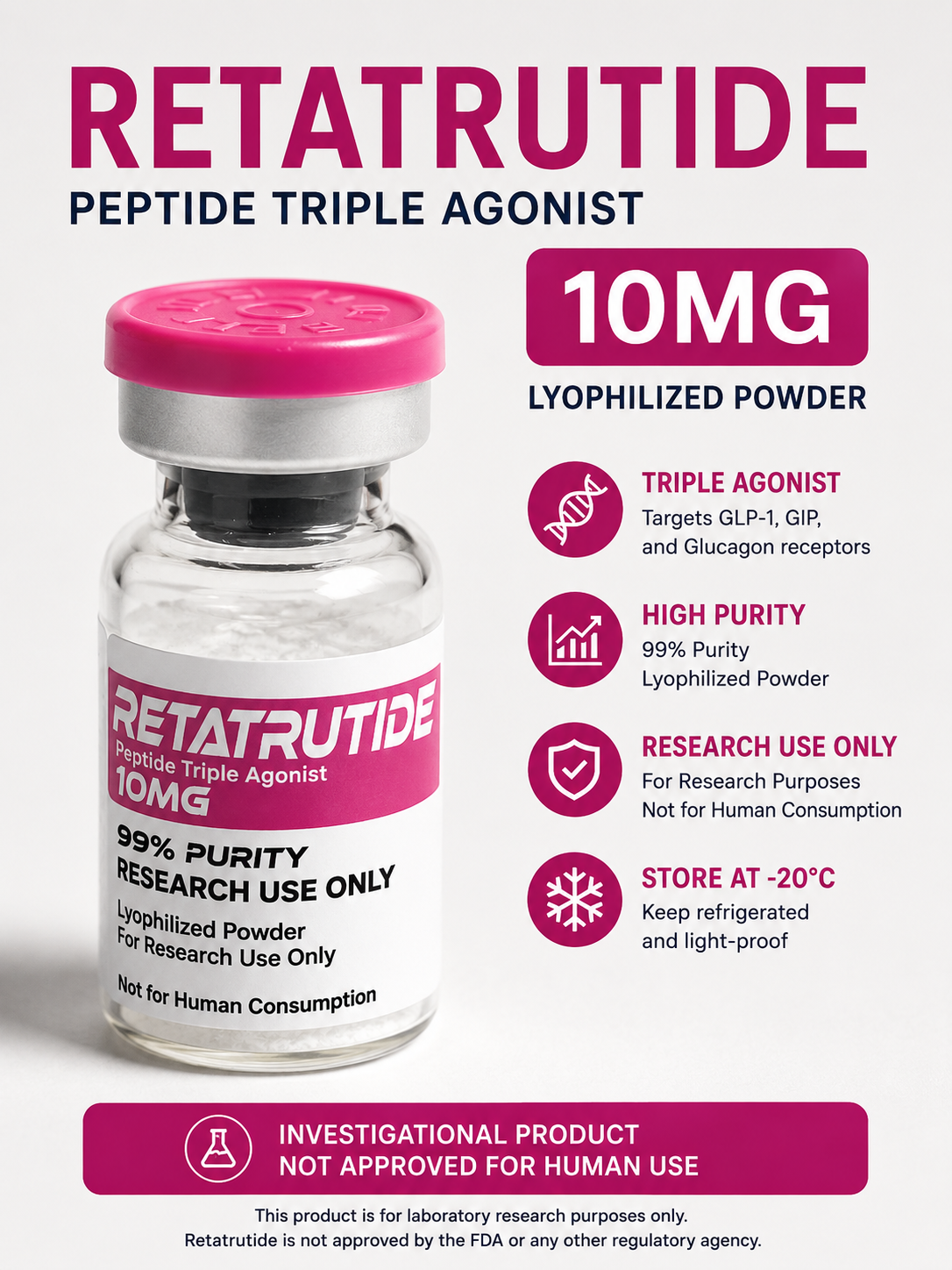



Leave a Reply